
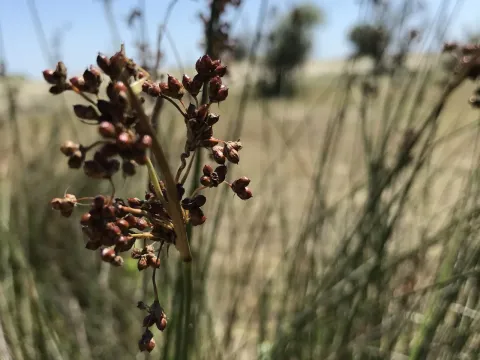
Coastal rush
Juncus littoralis
Coastal rush (Juncus littoralis) belongs to the Juncaceae family and is a robust perennial herb. Its natural habitat includes coastal areas, brackish marshes, and wet meadows, where the plant has evolved to thrive in soils with high moisture content and varying salinity levels.
What the section contains
Coastal rush
The crop prefers locations with consistent water supply and full sunlight. It performs best on heavy, loamy, or organic-rich soils that maintain moisture throughout the growing season. The plant's deep rhizomatous root system allows it to extract nutrients efficiently from wetland substrates.
Botanically, this species is characterized by dense clusters of cylindrical, stiff stems that arise from creeping rhizomes. This structural design enables the plant to act as a natural stabilizer, preventing soil erosion along riverbanks, ponds, and agricultural irrigation canals.
Regarding climatic requirements, the plant is well-adapted to temperate zones with high humidity. It exhibits significant tolerance to fluctuations in water levels, although prolonged drought conditions should be avoided to ensure maximum biomass production and plant health.
In terms of agricultural utility, coastal rush is primarily used for ecological land management and shoreline protection. It is increasingly recognized for its role in sustainable farming as a phytoremediation tool, assisting in the filtration of water runoff in agricultural landscapes.
Common pathological threats include fungal infections like rusts and leaf spots, which typically occur in overcrowded stands with poor air circulation. Maintaining proper spacing and managing water flow are critical strategies to minimize the impact of these pathogens during the peak growing phase.
Insect pests such as stem-boring larvae can cause damage to the internal tissues, weakening the plant's structural integrity. Monitoring for signs of infestation in the early spring is recommended to prevent significant yield losses in managed stands of the plant.