
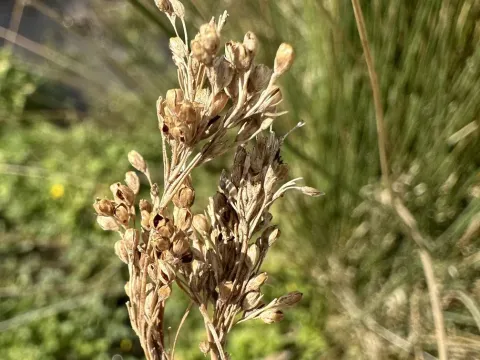
Broom rush
Juncus sarophorus
Broom rush (Juncus sarophorus) is a robust perennial herb belonging to the Juncaceae family. Originally native to Australia, this species is highly regarded for its ability to thrive in waterlogged environments where conventional crops fail to establish or provide economic yields.
What the section contains
Broom rush
The plant exhibits unique botanical features, including resilient, cylindrical stems that provide significant structural integrity. These features allow the plant to withstand periodic inundation, making it a valuable candidate for land restoration projects and riparian management.
In terms of cultivation requirements, Juncus sarophorus prefers high-moisture sites with abundant sunlight. While it can adapt to various soil types, it performs best in soils with high organic content that maintain consistent moisture levels throughout the growing season.
Agronomically, the establishment of a planting site requires careful water management. Given the plant's natural habitat, it is perfectly suited for low-lying areas or margins of agricultural plots where drainage is inherently poor.
The primary economic use of this culture includes phytoremediation, as it helps in absorbing excess nutrients from water runoff, as well as providing raw material for artisanal weaving and erosion control along embankments.
Broom rush is noted for its exceptional resistance to common agricultural pathogens. Due to its physiological structure and preference for saturated environments, it is largely unaffected by the typical fungal and bacterial diseases that impact agricultural fields.
The greatest threat to this crop is not disease, but environmental stress caused by severe and prolonged drought. When the soil moisture drops significantly, the plant's metabolic processes slow down, leaving it vulnerable to secondary colonization by opportunistic pests.
Pest pressure on Juncus sarophorus is generally negligible. Because the plant occupies a specific ecological niche, most generalist agricultural pests do not recognize it as a suitable host, reducing the need for chemical intervention.
Best practices for site management involve regular monitoring of hydrological parameters rather than pest scouting. Keeping the plant in a vigorous state through adequate moisture management is the most effective form of disease prevention.
In cases where environmental conditions favor the spread of weeds or unwanted woody species, manual clearing or prescribed management is recommended to preserve the integrity of the broom rush stand and ensure uniform development.