
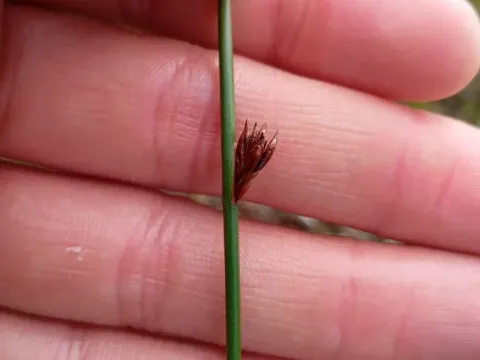
Arctic rush
Juncus arcticus
Arctic rush is a perennial herbaceous plant belonging to the Juncaceae family. It is a rhizomatous species characterized by its high resilience to cold temperatures and its ability to thrive in the harsh environments of the Arctic and Subarctic regions, extending into mountainous areas.
What the section contains
Arctic rush
The plant features stiff, cylindrical stems reaching heights between 15 and 50 cm, growing from a robust, creeping rhizome. Morphologically, the leaves are reduced to basal sheaths, an evolutionary adaptation that helps the plant conserve energy and maintain stability in unstable soil substrates common to its habitat.
Regarding its ecological requirements, Arctic rush is a hydrophilous plant. It thrives in wet meadows, the edges of ponds, lake shores, and marshes. Its capacity to perform gas exchange through specialized aerenchyma tissue allows it to survive in waterlogged, anaerobic conditions that would inhibit most other vegetation.
The species is highly adaptable to various soil types, particularly acidic peat or alluvial soils found in high-latitude regions. Its growth pattern involves spreading through rhizomes, which creates a dense underground network that stabilizes soil and prevents erosion in vulnerable wetland ecosystems.
In terms of agricultural and environmental use, Arctic rush is primarily managed for soil stabilization and phytoremediation. While it is not a primary forage crop, it provides essential ground cover and ecological stability in regions where few other vascular plants can successfully establish a population.
The health of Arctic rush is occasionally compromised by fungal pathogens, particularly those that thrive in saturated environments. Rust fungi and various leaf-spotting diseases are the most common afflictions, which can reduce the vigor of the plant during short, intensive growing seasons.
Insects rarely cause significant economic damage to this species, as the dense, fibrous nature of the stems acts as a natural deterrent. However, occasional mining by larvae of specific insect species can be observed, though these occurrences are rarely severe enough to require direct control measures.