
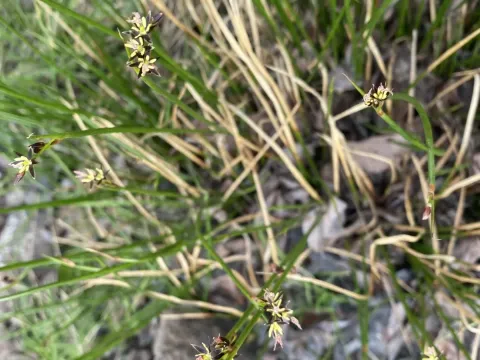
Bering rush
Juncus beringensis
Bering rush (Juncus beringensis) belongs to the Juncaceae family and represents a specialized perennial plant species adapted to the harsh environments of the North Pacific and Arctic regions.
What the section contains
Bering rush
The distribution of this species is centered around the Bering Sea, covering coastal areas of Chukotka and Alaska. It thrives in hydromorphic soils, including marshes, bogs, and saturated coastal plains that provide the necessary moisture for its growth.
Regarding climate requirements, the species demonstrates significant frost tolerance. It is fully adapted to short growing seasons, low temperatures, and the intense, continuous light typical of the high-latitude summer period.
Botanically, it forms dense tufts or tussocks with linear leaves, a classic adaptation to reduce water loss while maintaining gas exchange in waterlogged conditions. Its root system is exceptionally efficient at navigating oxygen-poor, saturated substrates.
Economically, while not a commercial crop in the traditional sense, it serves as a critical component of natural grazing lands for reindeer. It is also of great interest for environmental restoration projects aimed at stabilizing soils in permafrost-affected regions.