
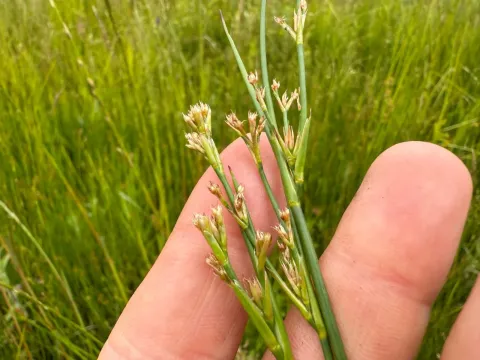
Blunt-flowered rush
Juncus subnodulosus
The blunt-flowered rush (Juncus subnodulosus) is a perennial herbaceous plant belonging to the Juncaceae family. It is distinctively adapted to wetland habitats, frequently found in fens, marshy grasslands, and along the banks of alkaline or calcareous water bodies.
What the section contains
Blunt-flowered rush
The plant features robust, creeping rhizomes that allow it to form dense stands in saturated soils. The stems are characterized by internal septa, which provide structural integrity and a distinctive appearance that is highly recognizable within the Juncus genus.
Regarding cultivation requirements, this species thrives in wet, nutrient-rich soils that maintain a high water table throughout the growing season. It performs exceptionally well in temperate climates, showing significant resilience to fluctuations in seasonal temperature as long as water remains available.
The geographical distribution of the species spans across Europe, the Caucasus, and parts of Western Asia. It is primarily managed as a wild plant rather than an intensive crop, contributing significantly to the stability of wetland areas and supporting diverse ecological niches.
In terms of agricultural and environmental utility, the blunt-flowered rush is increasingly valued for phytoremediation purposes. It is capable of absorbing excess nutrients from water, making it a key plant for constructing artificial wetlands and maintaining healthy water cycles in agricultural landscapes.
Common health issues for this plant include various fungal pathogens such as rust and leaf spot diseases, which typically develop under conditions of poor air circulation or stagnant water. Root rot may occur if the substrate becomes overly compacted or contaminated.
Pests affecting the species primarily consist of stem-boring insects and aphids that exploit the succulent tissues of the growing stalks. Additionally, large herbivores may cause mechanical damage to the stands if the area is overgrazed during the peak of the growth cycle.