
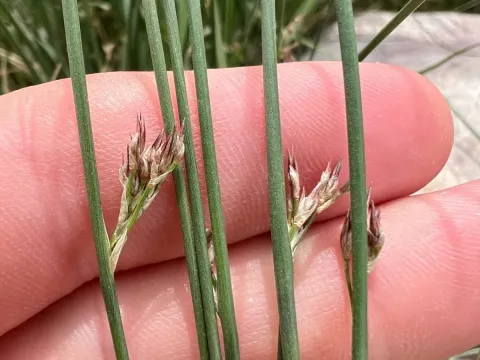
Baltic rush
Juncus balticus
Baltic rush (Juncus balticus) is a perennial, rhizomatous herb belonging to the Juncaceae family. It is a highly resilient plant species frequently found in coastal and wetland ecosystems.
What the section contains
Baltic rush
The plant thrives in full sun and is well-adapted to sandy, gravelly, or silty soils. It is particularly known for its salt tolerance, which allows it to flourish in brackish environments near seashores and saline lake banks.
Climate adaptability is a strong suit of the Baltic rush, as it withstands harsh winters and significant temperature fluctuations. It requires high moisture availability and is most productive in sites with consistently damp soil.
The botanical structure consists of creeping, deep-seated rhizomes that help in vegetative expansion. The stems are stiff, round, and leafless, usually reaching heights between 30 and 80 centimeters.
Due to its dense root system, the Baltic rush is excellent for soil stabilization and is considered a pioneer species in reclaiming eroded coastal areas.
While not a traditional food crop, Baltic rush has historically been valued for its material properties in craftwork, such as basketry and rope-making, thanks to the durability of its culms.
Current хозяйственное use is largely ecological. It is utilized in phytoremediation projects to help filter pollutants from water and improve soil quality in degraded industrial areas.
In landscaping, it is used for aesthetic and practical purposes to create buffer zones around ponds and artificial wetlands to prevent shoreline erosion.
Biomass production is generally low compared to intensive agricultural grasses, but it can be harvested for fiber-based products that require high tensile strength.
The economic value is primarily realized through ecosystem services rather than direct harvest, making it a vital plant for sustainable environmental management.
Baltic rush possesses strong natural resistance to pests and diseases, which is typical for specialized wetland vegetation that has evolved in harsh environments.
The main threats to the plant's health are environmental, particularly drainage of wetlands and habitat destruction that disrupts the necessary hydrological cycles.
Over-saturation and prolonged stagnation of water in artificial setups can sometimes encourage fungal growth, although this is rare in natural, flowing, or well-drained environments.
Competition from aggressive, fast-growing invasive plant species can crowd out Baltic rush populations, especially when nutrient levels in the soil are artificially inflated.
The plant is generally immune to common agricultural pests, as the structural composition of the stems is not easily digestible by most insects.