
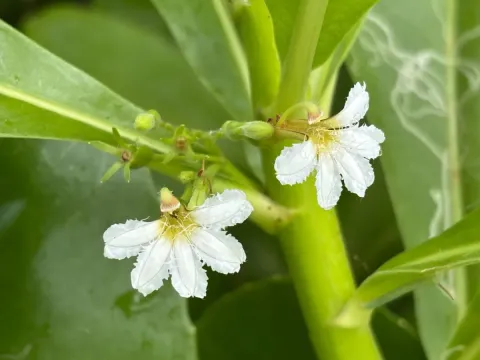
Scaevola taccada
Scaevola taccada
Scaevola taccada is a prominent evergreen shrub belonging to the Goodeniaceae family. Widely recognized as beach cabbage, it naturally thrives in the coastal zones of the tropical Indo-Pacific, demonstrating remarkable tolerance to salt spray and saline soil environments.
What the section contains
Scaevola taccada
The plant exhibits a robust structure, often reaching heights of up to 4 meters, with succulent, bright green leaves arranged in terminal rosettes. The most distinct botanical feature is its fan-shaped flowers, which give the genus Scaevola its common name in many languages.
Cultivation requires well-draining, sandy soils that mimic its native beach habitat. It is a heliophilic species, meaning it demands direct sunlight for optimal growth. It does not require high levels of soil fertility, as it is naturally adapted to nutrient-poor, sandy coastal substrates.
Agricultural practices for this species focus primarily on site preparation and erosion management rather than traditional intensive farming. When grown in nurseries or coastal reforestation projects, it is essential to ensure adequate spacing to allow for its characteristic broad, spreading habit.
The primary utility of Scaevola taccada is in environmental management, specifically as a stabilization agent for dunes. Its extensive root system prevents sand erosion, while its dense foliage provides a critical habitat for various coastal fauna in tropical island ecosystems.
Despite its toughness, Scaevola taccada can be prone to infestations by mealybugs and scale insects, especially when environmental stress levels are high. Root rot can occur in poorly drained conditions, which highlights the importance of maintaining appropriate soil moisture levels for healthy development.