
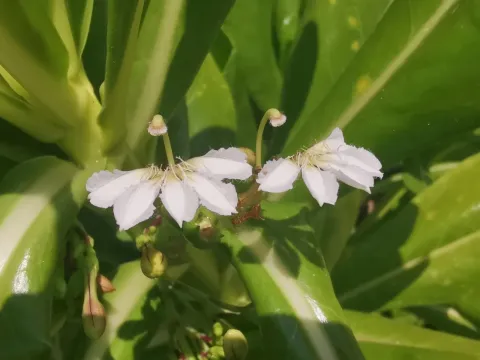
Scaevola
Scaevola L.
Scaevola L. is a genus of flowering plants belonging to the Goodeniaceae family. Known commonly as the fan flower due to its unique petal arrangement, this plant is native to the coastal regions of Australia and the Pacific Islands, where it thrives in warm and temperate climates.
What the section contains
 Fairy fan-flower
Scaevola aemula R. Br.
Fairy fan-flower
Scaevola aemula R. Br.
 Scaevola albida
 (Sm.) Druce
Scaevola albida
Scaevola albida (Sm.) Druce
 Scaevola humilis
 R. Br.
Scaevola humilis
Scaevola humilis R. Br.
 Scaevola phlebopetala
 F. Muell.
Scaevola phlebopetala
Scaevola phlebopetala F. Muell.
 Scaevola saligna
 G. Forst.
Scaevola saligna
Scaevola saligna G. Forst.
 Scaevola thesioides
 Benth.
Scaevola thesioides
Scaevola thesioides Benth.
 Shining fan-flower
Scaevola nitida R. Br.
Shining fan-flower
Scaevola nitida R. Br.
 Thick-leaved fan-flower
Scaevola crassifolia Labill.
Thick-leaved fan-flower
Scaevola crassifolia Labill.
Scaevola
Botanically, Scaevola species are recognized for their succulent-like foliage and trailing habit. While they are perennial in their natural habitats, in most agricultural and gardening applications, they are managed as annuals because they lack frost tolerance and require consistent warmth to bloom effectively.
The plant requires full sun exposure to maintain its compact shape and maximize flower production. It flourishes in light, well-draining, and nutrient-rich soil. When grown in containers, a high-quality potting mix with added perlite is essential to prevent water accumulation at the roots.
Effective irrigation is a critical component of Scaevola agronomy. The plant needs a steady supply of water to remain productive, but it is highly susceptible to root damage caused by prolonged waterlogging. Therefore, a balance must be maintained to keep the soil moist but not soggy.
Nutritional management is key to sustained flowering. Regular application of liquid fertilizer, particularly formulas rich in potassium, supports the plant's high metabolic needs during its intensive growth cycle. This ensures the continued development of its characteristic fan-shaped blooms.
The primary threats to Scaevola are soil-borne fungal pathogens, particularly root rot, which typically occurs under poor drainage conditions. Preventing these issues requires strict attention to soil composition and avoidance of over-saturation in the rhizosphere.
Foliar diseases, such as gray mold (Botrytis), can develop when the plant is kept in environments with high humidity and insufficient air circulation. Proper spacing between plants and well-ventilated areas are essential mitigation strategies for these conditions.
Pests such as aphids often colonize the tender tips of the stems, causing stunted growth and leaf curling. Integrated pest management, including the use of soaps or systemic insecticides, is recommended upon the first sign of infestation.
Whiteflies are another common concern, especially in greenhouse conditions. They thrive in warm environments and can quickly weaken the plant by sap-feeding. Regular monitoring and the use of sticky traps can help in early detection and management.
Spider mites may become a problem during hot and dry periods. They typically inhabit the underside of leaves, leading to chlorosis. Maintaining adequate environmental humidity and using appropriate miticides are standard methods to control these pests and preserve plant vigor.