
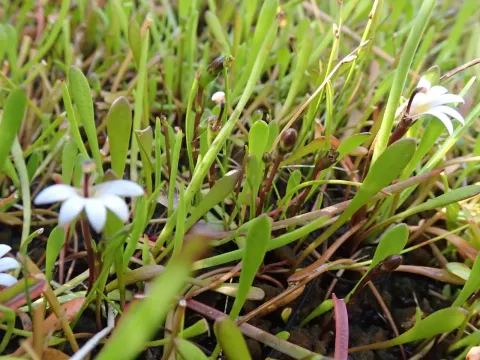
Selliera
Selliera
Selliera belongs to the Goodeniaceae family and is recognized as a distinctive perennial groundcover. The most prominent species, Selliera radicans, is native to the coastal regions of Australia, New Zealand, and parts of Chile. This plant is renowned for its evolutionary adaptation to saline coastal soils and moist environments, making it a highly specialized plant for particular landscapes.
What the section contains

Selliera
Botanically, Selliera is characterized by its prostrate habit, where creeping stems root at the nodes to form dense, mat-like patches. The leaves are fleshy, lanceolate, or spatulate, maintaining a vibrant green color throughout the growing season. This dense coverage effectively suppresses weed growth and provides a stable surface that aids in soil erosion control in coastal areas.
Climate requirements for Selliera are primarily oriented towards temperate, humid regions. It exhibits high tolerance to salt spray, which is a major advantage for gardens situated near the coast. While the plant prefers open, sunny locations, it can tolerate partial shade, provided the light intensity is sufficient to support its low-growing, creeping habit.
Soil requirements focus on maintaining consistent moisture. Selliera performs best in sandy or silty soils that are rich in organic matter but have good internal drainage. Despite its preference for wet environments, the plant is susceptible to root rot if water remains stagnant for extended periods, so a balance between moisture retention and soil aeration is essential.
The agronomic maintenance of Selliera is relatively straightforward once the plant is established. Initial care involves regular watering and hand-weeding to allow the plant to form a closed canopy. Once established, it becomes highly competitive. Occasional pruning or trimming of the edges is recommended to manage its spread and maintain the desired boundaries within landscape designs.
The primary threats to Selliera involve fungal pathogens that proliferate in overly wet conditions or poor airflow. Diseases such as stem or root rot can cause significant damage to the matting structure if drainage is inadequate. Managing these risks involves ensuring that the soil is not permanently waterlogged and that the planting site has sufficient air circulation to dry the foliage quickly.
Pests such as slugs and snails are particularly problematic for Selliera due to its succulent, fleshy leaves. These mollusks can cause aesthetic damage and weaken the plant, especially during damp weather. Effective management strategies include the use of physical barriers or targeted molluscicides to protect the integrity of the groundcover, ensuring it remains healthy and aesthetically pleasing.