
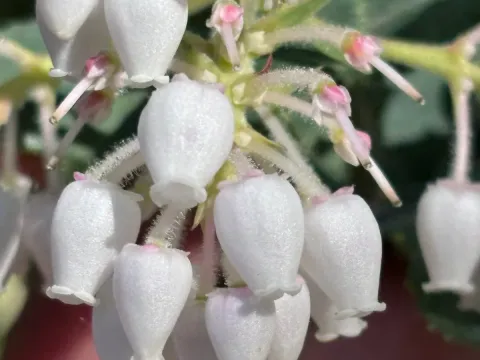
Anderson's manzanita
Arctostaphylos andersonii
Anderson's manzanita is a broad-leaved evergreen shrub belonging to the Ericaceae family. It is native to the Santa Cruz Mountains and surrounding regions of central California, where it thrives in chaparral and forest edge habitats.
What the section contains
Anderson's manzanita
Successful growth requires well-draining, sandy, or rocky soils with an acidic to neutral pH level. The plant is highly sensitive to root rot, making adequate drainage the most critical factor when selecting a planting site for this species.
This shrub is exceptionally drought-tolerant once established. It is evolved for the Mediterranean-type climate found in its native range, characterized by wet winters and long, dry summers where moisture is scarce.
The plant thrives under full sun exposure, which is necessary to maintain its dense, branching structure. Partial shade may be tolerated in extremely hot regions, but excessive shade will cause the plant to become leggy and lose its aesthetic appeal.
As a landscape plant, it serves as a valuable component for xeriscaping and ecological restoration. It is prized for its attractive, smooth, peeling bark and clusters of small, urn-shaped flowers that appear in early spring.
The primary biological threat to the species is Phytophthora, a water-mold that causes root and crown rot. Overwatering, especially during the warmer summer months, is the most common cause of mortality in cultivated specimens.
Insect pests such as scale insects and aphids may occasionally infest the foliage, particularly on plants under stress. While these rarely kill the shrub, they can weaken the plant and encourage secondary fungal infections.
Poor circulation within the shrub canopy can lead to outbreaks of powdery mildew, especially if plants are situated in areas with high humidity or are spaced too closely together.
Soil compaction is a significant environmental threat, as it reduces aeration to the roots and disrupts the natural mycorrhizal relationships that help the plant absorb nutrients in its native environment.
Mechanical damage to the thin, delicate bark can leave the plant vulnerable to wood-boring insects and opportunistic pathogens, so careful maintenance and avoidance of pruning tools near the trunk are advised.