
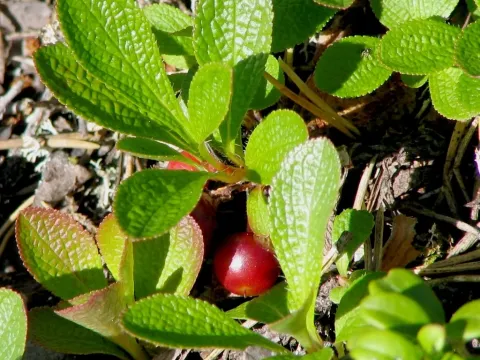
Alpine bearberry
Arctous
Propagation of Arctous alpina is challenging and typically involves seed sowing or careful division of established plants. Seeds have deep dormancy and require long-term cold stratification to germinate successfully.
What the section contains

Alpine bearberry
Sowing should be performed in a specialized acidic, peat-based substrate that mimics the plant's native alpine soil conditions. Maintaining high soil porosity and perfect drainage is crucial for seedling survival.
Vegetative propagation via cuttings is possible but requires specialized knowledge of ericaceous mycorrhizal fungi. Without this fungal symbiosis, root development remains minimal and often leads to plant failure.
Transplanting should be completed in early spring to take advantage of the natural moisture levels. Young plants require consistent monitoring for the first year to ensure they do not dry out or get smothered by surrounding vegetation.
As a member of the Ericaceae family, the plant requires a highly specific microenvironment that is difficult to replicate in standard agricultural settings, making initial establishment a delicate task.
Alpine bearberry requires highly acidic, well-draining soils with a pH between 4.0 and 5.5. Soil moisture must be consistent but never waterlogged, as poor drainage is the primary cause of root rot.
The plant thrives in full sun exposure. In southern climates or lower elevations, it requires light shade during the hottest parts of the day to prevent heat stress and metabolic imbalance.
This species is exceptionally cold-hardy, adapted to harsh arctic and alpine environments. It does not require winter protection, as it is evolved to withstand sub-zero temperatures and high wind conditions.
Nutrient requirements are low, but the presence of symbiotic mycorrhizal fungi is essential for nutrient uptake. Using synthetic high-nitrogen fertilizers is generally discouraged as it can inhibit fungal growth.
Avoid any soil amendments containing calcium or lime, as these elevate the pH levels and will induce severe chlorosis in the foliage, ultimately leading to plant death.
In a cultivated setting, the yield of Arctous alpina is typically modest. It is not considered a high-production agricultural crop but is valued for its specific phytochemical properties.
The fruit, a blackish berry, is rich in bioactive compounds, including tannins and organic acids. Harvesting is labor-intensive due to the plant's low-growth habit and relatively sparse fruiting compared to other berry species.
Commercial viability is limited, with most cultivation focusing on research or medicinal plant production. Mature plants reach full yield potential only after several years of consistent care.
Productivity is highly influenced by the health of the plant's root system and its symbiotic relationship with mycorrhizal fungi. Environmental stress significantly reduces the annual berry count.
The primary use remains in the pharmaceutical and nutraceutical sectors, where its extracts are sought after for their traditional medicinal properties.
The most significant threats to Arctous alpina include root-borne fungal pathogens such as Phytophthora, which thrive in poorly drained, moist soil conditions.
Pests are generally not a major concern due to the plant's natural chemical defenses. However, in greenhouse environments, spider mites can pose a risk if ventilation is inadequate.
Weed competition is a constant threat. The plant is a slow grower and cannot effectively compete with aggressive grasses or weeds, necessitating regular manual weeding.
Chlorosis, induced by improper soil pH or nutrient deficiencies, is a frequent physiological issue that weakens the plant's immune system, making it more susceptible to secondary infections.
Prevention relies on strict site preparation, ensuring that the planting area is free of pathogens and that the soil structure is permanently optimized for ericaceous species.
Harvesting is performed manually to ensure the integrity of the berries and the sensitive twigs of the plant. Timing is critical, usually occurring in late summer when the fruit is fully mature.
When collecting foliage for medicinal purposes, selective pruning is used. Only the healthy tips of the branches should be removed to minimize stress on the plant and allow for faster regeneration.
Post-harvest handling is essential; the berries have a short shelf life and must be processed or frozen immediately to prevent degradation of the bioactive compounds.
Drying of the leaves for pharmaceutical use is carried out in controlled-temperature environments (below 40°C) to preserve the volatile and phytochemical components of the plant material.
Storage of the finished product requires moisture-proof containers kept in cool, dark locations to maintain potency over an extended duration.