
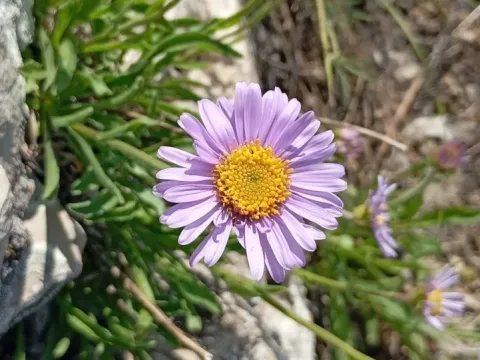
Aster
Aster L.
The sowing time for asters depends on the chosen cultivation method and climatic zone. When using the seedling method, seeds are sown in March or April into specialized trays filled with a nutrient-rich substrate.
What the section contains
 Alpine aster
Aster alpinus L.
Alpine aster
Aster alpinus L.
 Aster ageratoides
 Turcz.
Aster pseudoglehnii
Aster pseudoglehnii Y. S. Lim et al.
Aster ageratoides
Aster ageratoides Turcz.
Aster pseudoglehnii
Aster pseudoglehnii Y. S. Lim et al.
 Aster savatieri
 Makino
Aster savatieri
Aster savatieri Makino
 Bushy aster
Aster dumosus L.
Bushy aster
Aster dumosus L.
 Hayata Aster
Aster hayatae H. Lév. & Vaniot
Hayata Aster
Aster hayatae H. Lév. & Vaniot
 Indian aster
Aster indicus L.
Indian aster
Aster indicus L.
 Italian aster
Aster amellus L.
Italian aster
Aster amellus L.
 Korean aster
Aster koraiensis Nakai
Korean aster
Aster koraiensis Nakai
 Maack's Aster
Aster maackii Regel
Maack's Aster
Aster maackii Regel
 Ohara fleabane
Aster spathulifolius Maxim. x Aster pseudoglehnii Y. S. Lim et al.
Ohara fleabane
Aster spathulifolius Maxim. x Aster pseudoglehnii Y. S. Lim et al.
 Pyrenean aster
Aster pyrenaeus Desf. ex DC.
Pyrenean aster
Aster pyrenaeus Desf. ex DC.
 Spoon-leaved aster
Aster spathulifolius Maxim.
Spoon-leaved aster
Aster spathulifolius Maxim.
 Tatar aster
Aster tataricus L. f.
Tatar aster
Aster tataricus L. f.
 Tongolo aster
Aster tongolensis Franch.
Tongolo aster
Aster tongolensis Franch.
 Yomena Aster
Aster yomena (Kitam.) Honda
Yomena Aster
Aster yomena (Kitam.) Honda
Aster
For direct sowing into open ground, the timeline shifts to late April or May, once the soil has warmed up to 10–12 degrees Celsius. It is essential to avoid late frosts that could damage young shoots.
Some perennial aster species can be sown before winter, in October or November, using dry seeds in frozen ground. This process ensures natural stratification and promotes early germination in the spring.
The optimal planting depth for seeds is no more than 0.5–1 centimeter. Planting too deep can significantly delay germination or result in the complete failure of the seeds to sprout.
The temperature for seed germination should be maintained between 18–20 degrees. Once massive shoots emerge, it is recommended to reduce the temperature to prevent the seedlings from becoming leggy.
Asters prefer well-lit areas sheltered from strong winds. The crop is demanding regarding soil fertility and performs best on light loams or sandy soils with a neutral acidity level.
Proper drainage is vital for successful growth, as water stagnation in the root zone is detrimental to most species. The site should be prepared in advance by incorporating organic fertilizers.
The crop responds positively to regular irrigation, especially during the active flower formation stage. However, excessive soil moisture promotes the development of fungal infections and root rot.
Mineral fertilizer applications are carried out in stages: nitrogen fertilizers at the beginning of vegetation, and phosphorus-potassium fertilizers during budding and flowering to improve vitality.
Crop rotation is critically important to prevent soil-borne infections. It is not recommended to plant asters after other members of the Asteraceae family, especially after previous aster crops or potatoes.
The primary threat to this crop is Fusarium wilt, caused by fungi of the Fusarium genus. This disease affects the root system, leading to yellowing of foliage and eventual plant death.
Damping-off (black leg) often affects seedlings under conditions of high humidity and poor ventilation. Prevention includes soil disinfection and timely thinning of the seedlings.
Powdery mildew manifests as a white coating on the leaves, significantly reducing the plant's photosynthetic activity. Systemic fungicides are typically used to combat this condition.
Among pests, aphids, spider mites, and tarnished plant bugs pose the greatest danger. They damage young shoots and flower buds, sucking out cell sap and spreading viral infections.
To protect the crops, it is necessary to perform regular phytosanitary monitoring and apply insecticides as soon as the first signs of insect activity are detected.