
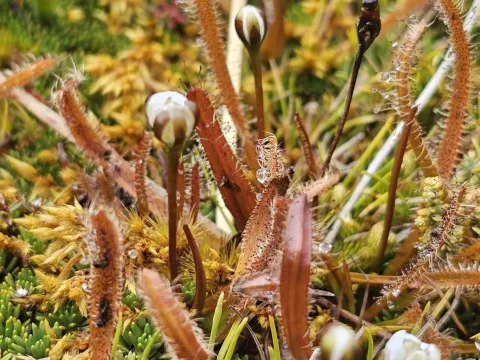
Sundew
Drosera L.
Sowing sundew seeds is typically performed in late winter or early spring. The seeds are extremely fine, resembling dust, and should be sown on the surface of a moist substrate without being buried to allow adequate light exposure for germination.
What the section contains
Sundew
Some species require a brief period of cold stratification to break dormancy. After sowing, containers are covered with plastic or glass to maintain high humidity levels, which is critical for the delicate germination process in these bog-native species.
Vegetative propagation, such as leaf cuttings, is a common and faster method for obtaining mature plants. Leaf cuttings are placed on a damp medium, where they eventually develop adventitious buds and new root systems.
Transplanting seedlings requires extreme care due to the fragile nature of their root systems. Maintaining a stable temperature between 20 and 25 degrees Celsius and providing consistent bright light are essential for the survival of young sundews.
Acclimatization of seedlings to ambient room conditions should be a gradual process. Moving plants from high-humidity propagating chambers to standard environments must be done over several weeks to prevent desiccation.
Sundew belongs to the Droseraceae family and is a specialized carnivorous genus adapted to nutrient-poor, acidic environments. Its distribution is global, with native populations occurring on every continent except for Antarctica.
The growing medium must be acidic and lack traditional mineral fertilizers. A mixture of long-fibered sphagnum peat and perlite or silica sand is ideal for creating an open, airy structure that retains moisture without becoming compacted.
Water quality is of paramount importance for the health of Drosera. Only distilled, rainwater, or reverse osmosis water should be used, as minerals found in tap water can quickly cause toxicity and damage to the roots of the plants.
High light intensity is required to trigger the production of digestive enzymes and the characteristic sticky mucilage on the leaves. Without sufficient light, the plant will lose its vibrant coloration and struggle to trap insect prey.
Humidity levels should be kept high, ideally above 60 percent, as these plants have evolved in wetland habitats. Proper airflow must be maintained to prevent mold growth while ensuring the soil remains consistently moist.
Sundews are highly regarded in the pharmaceutical industry for their pharmacological properties, including antibacterial and antispasmodic effects. Their bioactive compounds, such as plumbagin, are used in various medical preparations.
In commercial cultivation, the yield is measured by the biomass produced in controlled greenhouse environments. The cycle requires precise management of light, photoperiod, and nutrition to optimize the concentration of active medicinal ingredients.
The ornamental plant trade values sundews for their exotic appearance and biological curiosity. Collectors seek out rare species, and healthy, well-developed specimens command high prices in the botanical plant market.
Sundews also serve a functional role as natural pest control agents in greenhouses. By capturing small flying insects, they assist in managing pest populations without the need for synthetic chemical insecticides or heavy intervention.
Sustainability in yield relies on maintaining the delicate balance of the plant's health. Providing access to insect prey remains the most natural way to boost growth rates and ensure the plant reaches its full potential in a cultivated setting.
Fungal infections, often caused by stagnant, waterlogged conditions and poor air circulation, are the primary threat to sundews. Botrytis and other molds can spread rapidly, causing necrosis of the leaves and eventual death of the entire plant.
Aphids are frequent pests that infest the tender foliage, feeding on cell sap and weakening the plant's structural integrity. Manual removal or the use of mild, organic-approved soaps is usually preferred over harsh systemic insecticides.
Spider mites can become a major issue when environmental humidity is too low. Consistent monitoring and maintaining high moisture levels around the foliage are effective preventative measures against these persistent pests.
Mealybugs can be problematic, often hiding in the crevices of the rosette. If an infestation occurs, careful cleaning with an alcohol-soaked swab or the application of specialized systemic treatments may be required to protect the specimen.
Substrate mineral accumulation, often stemming from poor quality water, causes severe root stress. Symptoms include leaf tip browning and lack of growth, which can be mitigated by repotting in fresh, clean media and strictly monitoring water quality.