
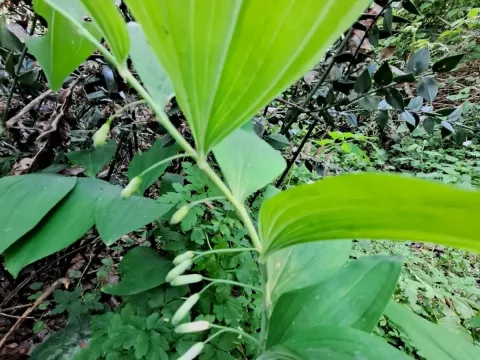
Solomon's seal
Polygonatum
Propagation of Solomon's seal for agricultural or ornamental purposes is most often carried out vegetatively, specifically through the division of rhizomes. The optimal time for this operation is late August or early September, when the above-ground part of the plant begins to die back.
What the section contains
 Eastern Solomon's seal
Polygonatum orientale
Eastern Solomon's seal
Polygonatum orientale
 Giant Solomon's seal
Polygonatum macranthum
Giant Solomon's seal
Polygonatum macranthum
 Great Solomon's seal
Polygonatum commutatum
Great Solomon's seal
Polygonatum commutatum
 Hairy Solomon's seal
Polygonatum hirtum
Hairy Solomon's seal
Polygonatum hirtum
 Hybrid Solomon's Seal
Polygonatum hybridum
Hybrid Solomon's Seal
Polygonatum hybridum
 Hybrid Solomon's seal
Polygonatum hybrids
Hybrid Solomon's seal
Polygonatum hybrids
 Inflated Solomon's seal
Polygonatum inflatum
Inflated Solomon's seal
Polygonatum inflatum
 Involucrate Solomon's seal
Polygonatum involucratum
Involucrate Solomon's seal
Polygonatum involucratum
 Polygonatum acuminatifolium
Polygonatum acuminatifolium
Polygonatum acuminatifolium
 Polygonatum falcatum
Polygonatum graminifolium
Polygonatum graminifolium
Polygonatum falcatum
Polygonatum falcatum
Polygonatum graminifolium
Polygonatum graminifolium
 Polygonatum humile
Polygonatum humile
Polygonatum humile
 Polygonatum lasianthum
Polygonatum lasianthum
Polygonatum lasianthum
 Polygonatum punctatum
Polygonatum punctatum
Polygonatum punctatum
 Smooth Solomon's seal
Polygonatum glaberrimum
Smooth Solomon's seal
Polygonatum glaberrimum
 Solomon's seal
Polygonatum multiflorum
Solomon's seal
Polygonatum multiflorum
 Solomon's seal
Polygonatum odoratum
Solomon's seal
Polygonatum odoratum
 Solomon's seal
Polygonatum biflorum
Solomon's seal
Polygonatum biflorum
 Whorled Solomon's seal
Polygonatum verticillatum
Whorled Solomon's seal
Polygonatum verticillatum
Solomon's seal
Seed propagation of Solomon's seal is less common due to a long development cycle and low seed germination rates. Seeds require mandatory stratification for several months, so they are sown before winter directly into open ground or special containers.
During vegetative division, each segment of the rhizome must have at least one active renewal bud. Planting areas must be cleared of weeds, as the crop is extremely sensitive to competition for nutrients during its first year of life.
The planting depth is about 10-15 centimeters, depending on the soil composition. The spacing between rows should be at least 40-50 centimeters to ensure adequate air circulation and ease of maintenance.
To create optimal growth conditions, it is recommended to enrich the soil with organic fertilizers, such as well-rotted compost or leaf mold, before planting the material.
Solomon's seal belongs to the Asparagaceae family and prefers conditions that are as close as possible to its natural habitat in woodland areas. The plant develops best in shaded or semi-shaded areas with protection from direct sunlight.
For normal development, the crop requires fertile, loose, and sufficiently moist soil. Loamy soils with a neutral or slightly acidic pH, rich in organic matter, are considered ideal.
The crop is highly winter-hardy, a characteristic typical of temperate climate species. In harsh winters with little snow, mulching the root system with peat or fallen leaves is recommended to prevent frost damage.
The moisture-loving nature of Solomon's seal requires regular watering during dry periods, especially in the spring during the active growth phase of the shoots. However, stagnant water in the rhizome zone is strictly unacceptable, as it leads to rot.
The plant does not tolerate soil compaction, so regular hoeing of the rows is a critical agronomic measure to ensure proper aeration of the root system.
The main danger for Solomon's seal comes from fungal diseases that develop under conditions of excessive humidity. Leaf spot, caused by pathogenic fungi that attack the leaf blades during rainy periods, is frequently observed.
Among pests, sawfly larvae cause the most damage to plantations, as they are capable of completely destroying the above-ground part of the plant in a short time, skeletonizing the leaves down to the veins.
Damage to rhizomes by wireworms and May beetle larvae is also possible, as they bore through the fleshy storage organs, weakening the plant and making it susceptible to secondary infections.
To prevent the spread of infections, it is necessary to promptly remove and destroy plant debris at the end of the season. In the case of mass infestation, systemic insecticides are applied.
Adhering to crop rotation and avoiding overcrowded plantings are the best methods of disease control, helping to maintain the phytosanitary condition of the plot at the proper level.
The medicinal raw material of Solomon's seal consists primarily of rhizomes, which are harvested 3-4 years after planting the crop. The optimal harvesting period is late autumn after the death of the above-ground mass or early spring.
The rhizomes are dug up, thoroughly cleaned of soil, washed in cold running water, and small roots and damaged areas are removed. The cleaned material is cut into fragments to speed up the drying process.
Drying of the raw material is carried out in well-ventilated rooms, under shelters, or in special dryers at a temperature not exceeding 50 degrees Celsius to preserve biologically active substances.
Correctly dried raw material should be hard, yellowish-white on the fracture, and free of any signs of mold. It is recommended to store the finished product in paper bags or wooden boxes in dry, dark places.
Adhering to the harvesting technology allows the medicinal properties of the plant to be preserved, including the content of glycosides and alkaloids, which are used in traditional and official medicine.