
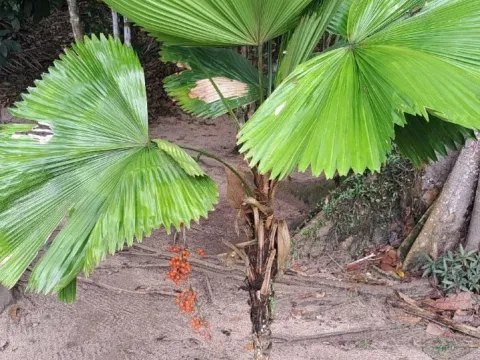
Licuala
Licuala
Licuala is a genus of perennial plants in the Arecaceae family, highly valued for its striking, fan-shaped leaves. These palms are native to the tropical rainforests of Southeast Asia and Oceania, where they grow as understory plants in humid, shaded environments. In agriculture and horticulture, they are categorized as ornamental tropical crops.
What the section contains
 Licuala acutifida
Licuala acutifida
Licuala acutifida
 Licuala amplifrons
Licuala amplifrons
Licuala amplifrons
 Licuala bintulensis
Licuala bintulensis
Licuala bintulensis
 Licuala cabalionii
Licuala cabalionii
Licuala cabalionii
 Licuala cordata
Licuala cordata
Licuala cordata
 Licuala ferruginea
Licuala ferruginea
Licuala ferruginea
 Licuala grandis
Licuala grandis
Licuala grandis
 Licuala mattanensis
Licuala mattanensis
Licuala mattanensis
 Licuala orbicularis
Licuala orbicularis
Licuala orbicularis
 Licuala peltata
Licuala rumphii
Licuala rumphii
Licuala peltata
Licuala peltata
Licuala rumphii
Licuala rumphii
 Licuala spinosa
Licuala spinosa
Licuala spinosa
 Licuala triphylla
Licuala triphylla
Licuala triphylla
Licuala
Botanically, these palms are characterized by deeply segmented, pleated leaf blades that emerge from a central stalk. The stems are generally short and robust, often covered by persistent leaf bases. The root system is quite fibrous and sensitive, requiring a medium that is consistently moist but never waterlogged to remain healthy.
Optimal growth requires a stable environment with temperatures between 20 and 28 degrees Celsius. The plant is extremely sensitive to cold drafts and sudden temperature fluctuations, which can cause severe browning of the foliage. During the winter, the temperature should not drop below 16 degrees Celsius to avoid dormancy or damage.
The soil requirements for Licuala demand a well-draining, nutrient-rich potting mix. A blend of peat moss, perlite, and high-quality loam is ideal for providing the necessary aeration. Since the roots are sensitive to rot, the container must have large drainage holes and a significant layer of coarse gravel or expanded clay at the base.
Regarding light, this palm prefers bright, filtered light. Direct sun exposure should be strictly avoided as it causes irreversible damage to the leaf structure. In indoor conditions, placing the plant near north or east-facing windows is usually sufficient, provided that the ambient humidity remains consistently high, around 60 to 70 percent.
Spider mites are the most frequent pest challenge for the Licuala palm, particularly in indoor settings with dry air. These microscopic pests thrive when humidity is low, causing the leaves to lose their deep green color and develop fine webbing. Regular misting and proper climate control are the best preventive measures.
Scale insects and mealybugs can also infest the stems and the undersides of the fan-shaped leaves. These pests suck the plant's sap, weakening it over time. If an infestation occurs, it is essential to treat the plant with appropriate horticultural oils or systemic insecticides to effectively eliminate the threat.
Fungal leaf spot diseases represent a major biological threat, usually triggered by stagnant air and excessive moisture on the leaf surfaces. Maintaining good air circulation is crucial to prevent the germination of fungal spores. If spots appear, infected foliage must be pruned away with sterilized tools to prevent further spread.
Root rot is the most devastating condition, usually caused by overwatering or poor drainage. Once the roots are compromised, the plant quickly loses its ability to absorb nutrients, leading to rapid decline. Re-potting into fresh, airy soil and trimming away damaged roots is necessary if this condition is caught in time.
Nutritional deficiencies can manifest as chlorosis or stunted growth, often due to an unbalanced pH level in the soil. To ensure the palm remains healthy, use a balanced liquid fertilizer formulated for palms during the active growing season. Always ensure the soil is slightly damp before applying any liquid nutrients.