


SKU #3510
·
631 views
Apple Rossoshanskoe Striped
Apple
User rating
1 vote100% positive reviews
No ratings yet — be the first.
Type of Sort
Winter Apple Variety
Store offers · 2 from 2 stores
Prices are updated on loadLoading offers…
Available at: Питомник Дяди Бори · Экоферма22 · Садовая Деревня
Aggregator catalog: prices are collected automatically from store websites, normalized by AI and converted at the current exchange rate. Before ordering, confirm the price and availability on the store's website. This block is not indexed by search engines — the data is loaded after the page opens.
About product

Winter variety selected at the Rossoshanskaya Zonal Experimental Station for Horticulture. Developed in the 1920s by M. M. Ulyanishchev from seeds of Kronsel's transparent open-pollinated variety, presumably 'Aport Red'. Widely cultivated in both amateur and commercial orchards.
Trees are medium-sized, with oval crowns in youth, which become round-spreading with hanging branches upon fruiting.…
Type of Sort
Winter Apple Variety
Description
Winter variety selected at the Rossoshanskaya Zonal Experimental Station for Horticulture. Developed in the 1920s by M. M. Ulyanishchev from seeds of Kronsel's transparent open-pollinated variety, presumably 'Aport Red'.
Widely cultivated in both amateur and commercial orchards.
Trees are medium-sized, with oval crowns in youth, which become round-spreading with hanging branches upon fruiting. Main branches have greenish-brown bark, initially pointing upward, but with age they spread outward and droop downward at the tips. Fruit set is concentrated on two- to four-year-old wood — on terminal buds, spurs, and short shoots, as well as on terminal growths of the previous year.
Shoots have grayish-brown bark, long, slightly curved, medium thickness, weakly hairy; buds are small to medium, sparsely distributed at the surface level. Buds are pressed against the shoot, conical, with outer scales grayish-brown.
Leaves are large, nearly round with a short apex and rounded base, with three-toothed serrated edges, dark green. Leaf blade is nearly flat with a slightly convex surface and wrinkled texture. Leaf arrangement is mostly at acute, occasionally right angles to the shoot on long petioles, with small stipules.
Inflorescence — a panicle with moderate flower count. Flowers are white, with cup-shaped corolla, not double, medium-sized. Petals are entire, not fused. Stigma styles are positioned at the same level as the stamens. Flower stems are of medium length. Flowering occurs in early to mid-season.
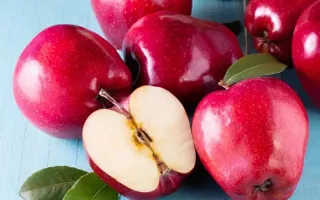
Fruits are large, slightly flattened, round-conical, single-seeded, even, with smooth, flat surfaces. Skin color is light green, turning greenish-yellow upon ripening, with a cover of dark red, more or less wide stripes that merge on the sun-exposed side into a diffuse streaked blush. Subcutaneous spots are moderately visible. Skin is smooth, matte or slightly glossy. Rust is absent in most fruits. Pedicel is long, medium thickness, with a medium, wide calyx. Receptacle is medium depth and width, with smooth surface; calyx is half-open; calyx tube is small, conical. Central cavity is absent. Core is medium-sized, onion-like. Seeds are medium-sized, convex, dark brown.
Flesh is light green, slightly acidic-sweet, medium aromatic, very juicy, medium firmness, tender. Fruit appearance is very attractive, flavor excellent. Chemical composition of fruit: total sugar — 10.9% (9.8–11.9%); titratable acids — 0.44% (0.23–0.58%) on fresh weight; ascorbic acid — 14.9 mg/100g (9.2–19.7); pectic substances — 0.69% (0.33–0.99%) on dry weight.
By harvest readiness, it belongs to medium or more often late-ripening varieties; by consumer readiness — to early-winter types. Fruit drop is absent. Fruit storage life reaches 150 days. Transportability of fresh fruit and their marketability are high.
Trees enter fruiting early, at 4–5 years after grafting in nurseries. In the first fruiting period, under Voronezh region conditions, average yield per tree was 150–170 kg, while Antonovka yielded 90 kg at this age. Average yield per hectare over the years is 220–250 centners. It surpasses all varieties studied at the Rossoshanskaya Station in terms of yield. In early fruiting years, under favorable conditions, fruiting is regular. Yield increase, insufficient soil moisture lead to periodic fruiting.
Winter hardiness of the tree is very high. Throughout the variety's history, significant freezing damage has not been observed. Spring frosts may damage flowers. For example, in 1999, a frost down to -6°C, occurring during mass flowering on May 7, destroyed all flowers, resulting in no yield. In 2000, during May 2–20, seven temperature drops to -2°C occurred; flowers were partially damaged, but yield was high. The most damaging disease is scab, to which this variety shows exceptional sensitivity during epidemic years.
Advantages of the variety: high ecological adaptability, yield, marketability, biochemical composition, and flavor qualities.
Disadvantages of the variety: high sensitivity to scab.
When protected against scab, it is the highest-yielding variety with excellent marketable fruit.
Video · 8 videos
Suggest a video →Crop & resistance
Crop
Specifications
| Type of Sort | |
|---|---|
| Catalog | Catalog → Apple |
Not yet комментариев. Be the first!
Alternatives
Apple saplings · similar varieties




See also
Often considered together with this variety





Recently viewed
Products you’ve viewed on this site
Reviews · 0