


SKU #3520
·
1 588 views
Silver Hoof
Apple
User rating
1 vote100% positive reviews
No ratings yet — be the first.
Type of Sort
Winter Apple Variety
Store offers · 1 from 1 stores
Prices are updated on loadLoading offers…
Available at: Astrasad · Agromir
Aggregator catalog: prices are collected automatically from store websites, normalized by AI and converted at the current exchange rate. Before ordering, confirm the price and availability on the store's website. This block is not indexed by search engines — the data is loaded after the page opens.
About product

Summer variety from the Sverdlovsk Experimental Garden Station. Developed by L. A. Kotov by crossing Snowdrop with Rainbow. The leading summer variety in the Ural region, also recommended for the Volga-Vyatka and West Siberian regions. Actively propagated by nurseries and cultivated in Sverdlovsk, Perm, Chelyabinsk, Kurgan, Kirov regions, Orenburg, Udmurtia, and gaining popularity in other northe…
Type of Sort
Winter Apple Variety
Description
Summer variety from the Sverdlovsk Experimental Garden Station. Developed by L. A. Kotov by crossing Snowdrop with Rainbow. The leading summer variety in the Ural region, also recommended for the Volga-Vyatka and West Siberian regions. Actively propagated by nurseries and cultivated in Sverdlovsk, Perm, Chelyabinsk, Kurgan, Kirov regions, Orenburg, Udmurtia, and gaining popularity in other northern regions and Northern Kazakhstan. Approved since 1988.
Medium-sized or slightly smaller tree with a round, well-filled crown. Main branches have light yellowish bark, emerging from the trunk at nearly right angles. Branches are straight and compactly arranged. Fruit set is concentrated on buds, shoots, and last year’s growth.
Branches of medium thickness, straight, round in cross-section, brown, densely hairy. Leaves are light green, matte, oval or rounded in shape, with a rounded base and short-pointed apex. Leaf blade is flat, with slightly uplifted edges, moderately hairy. Leaf margin has fine double-toothed serration. Petioles are of medium length. Stipules are small, awl-shaped.
Flower buds are round, medium-sized, hairy. Flowers are medium to large, cup-shaped or broadly cup-shaped. Petal edges are entire, slightly uplifted. Petals are half-closed, white, like buds. Stigmas are at the same level or slightly above the stamens.
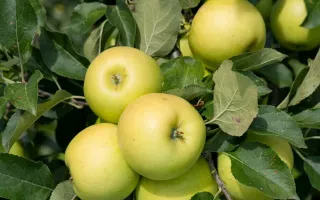
Fruits are medium-sized, averaging 80-90 g, one-dimensional, round with a smooth surface, with no or weak ribbing. Skin is not rough, dry, smooth, with a waxy coating. Subcutaneous dots are not visible. Main color is dense cream, covering color on most of the fruit surface is blurred or slightly striped orange-red, strongly expressed. Pedicel is short, straight, medium thickness. Calyx is medium depth and width, conical, slight rust, grayish-green. Receptacle is medium depth or shallow, with a smooth surface. Heart is medium size, onion-shaped, seed chambers are open and small. Subcalyx tube is short, medium width, cylindrical, widening towards the calyx. Seeds are medium size, full, round, dark brown.
Flesh is fairly firm, fine-grained, very juicy, pleasantly acidic-sweet with a good to excellent flavor, medium aroma. In fruits, the average content is: dry soluble substances — 12.5% (up to 17.8%), total sugars — 10.2% (up to 12.9%), titratable acids — 0.8%, ascorbic acid — 12.5 mg/100g, P-active substances (catechins) — 111.2 mg/100g.
In Yekaterinburg, fruits ripen mid-August and remain edible for one to one and a half months. If left on the tree until the end of August, they swell and become translucent. Further north, east, and south of the Sverdlovsk region, fruits ripen significantly earlier.
Silver Hoof fruits are attractive, one-dimensional, and well tolerate transportation. Main use is fresh consumption, also suitable for processing into juices, compotes, jams, drying, etc.
Self-sterile, well pollinated by other varieties. Due to small crown, dense planting schemes of 5-6 x 3 m are needed. In harsh climates, fruiting buds are short-lived, thus systematic pruning is desirable.
Trees begin fruiting on the 3rd-4th year after grafting and produce marketable yield within 1-2 years. Fruit set is regular. The variety is high-yielding. Silver Hoof has good winter hardiness. The variety is relatively disease-resistant.
Advantages of the variety: high early fruiting, high yield, restrained tree growth, early ripening, attractive and good-tasting fruits, suitability for various processing methods.
Disadvantages of the variety: under poor agronomy, fruits become smaller, in wet years, fruits are moderately affected by scab, and damaged fruits by fruit borers are affected by fruit rot.
The variety is very promising for breeding winter-hardy, early-fruiting summer-ripening varieties. New elite seedlings, including those from crosses with scab-immune donors, have been developed using this variety.
Video · 9 videos
Suggest a video →Crop & resistance
Crop
Specifications
| Type of Sort | |
|---|---|
| Catalog | Catalog → Apple |
Not yet комментариев. Be the first!
Alternatives
Apple saplings · similar varieties



See also
Often considered together with this variety



Recently viewed
Products you’ve viewed on this site
Reviews · 0