


SKU #3317
·
1 809 views
Golden Delicious
Apple
User rating
1 vote0% positive reviews
No ratings yet — be the first.
Type of Sort
Winter Apple Variety
Tree; Growth Power
Medium-height
Tree; Canopy Shape
Broad canopy
Fruit; Fruit Shape
Oblong-rounded-conical
Prices in stores
from2.95 €per seedling
pack from 0.32 € per pack
20 offers from 15 stores
Store offers · 20 from 15 stores
Prices are updated on loadLoading offers…
Available at: Biosad · Drevolaz · Green Optima · Greendecor · Корець-сад · Розплідник-Дачник · Плодосад · Posadka · Profisad · radosad-com-ua · Лопатинский сад · Sadova flora · Sadovodd · Sadpavliuka · Сади Буковини · Сади Валерії
Aggregator catalog: prices are collected automatically from store websites, normalized by AI and converted at the current exchange rate. Before ordering, confirm the price and availability on the store's website. This block is not indexed by search engines — the data is loaded after the page opens.
About product

American winter-ripening variety. Selected in the USA as a random seedling of unknown origin, it was singled out from the VNIIR collection for its early fruiting, high and regular yield (79 kg/tree), excellent taste qualities, good storability, resistance to diseases and pests. It has moderate drought and cold resistance. The variety has been widely adopted: it is regionally approved in all south…
Type of Sort
Winter Apple Variety
Tree; Growth Power
Medium-height
Tree; Canopy Shape
Broad canopy
Fruit; Fruit Shape
Oblong-rounded-conical
Description
American winter-ripening variety. Selected in the USA as a random seedling of unknown origin, it was singled out from the VNIIR collection for its early fruiting, high and regular yield (79 kg/tree), excellent taste qualities, good storability, resistance to diseases and pests. It has moderate drought and cold resistance. The variety has been widely adopted: it is regionally approved in all southern countries of the CIS and southern Russia. For more than 25 years, it was the main apple variety in European countries.
Medium-sized tree. Young trees have a conical crown, while fruiting trees have a broad, round, dense, well-leafed crown. Under heavy fruit load, branches droop, and the crown becomes weeping. Main branches diverge from the trunk at a sharp angle. Bark is dark gray. Fruit set is mixed, with clusters forming on 2-year-old and previous year’s growths, since each bud scar retains 3-4 fruits.
Medium-thick, curved, slightly knotted, light brown shoots with greenish tinge, slightly hairy, with large, oval, densely scattered stipules. Leaves are broadly ovate, with rounded base and slightly elongated tip, moderately lobed, margins doubly- or occasionally tri-toothed, slightly wavy. Hairs are sparse, color bright green, surface smooth and shiny. Leaf blade forms an acute angle with the stem. Petiole is long. Stipules are medium-sized, lanceolate. In nursery, one-year-old shoots are light brown with yellowish tinge and covered with large, distinct, rounded stipules or streaks. Leaves are strongly wrinkled, with thick petioles, broadly lanceolate stipules, leaf margins toothed and scalloped. Terminal buds have shortened internodes and strongly folded, wavy-edged leaves.
Flowers are medium-sized, bowl-shaped, white with slight pink tinge, with long hairy stigma, stigma positioned at pollen level.
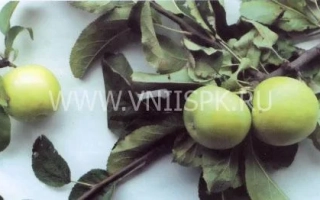
Fruits (see photo) are medium-sized and slightly larger (140-170 g on Kuban), round-conical, smooth, with dry, firm skin. Under favorable conditions, the skin is slightly rough (due to gray corky spots and streaks, sometimes merging into large patches), golden-light green, later turning yellow, occasionally with diffuse reddish blush on sun-exposed side. The fruit stalks on central fruits are medium-thick, on side fruits thinner but protrude beyond often deep calyx. Calyx is closed, but with gaps at base of long, half-twisted backward sepals; there are very small bumps in ray-like formation at base. Calyx is flat, narrow, shallow, occasionally medium. Sub-calyx tube is long, reverse-conical. Central cavity is small, with seed chambers either not connected or connected by very narrow slit.
Flesh is greenish when picked, sweet, firm, very juicy, turns creamy or light-yellow during storage, tender or more pungent, dessert flavor. Chemical composition: 14-20.5% dry matter, 10-13.8% sugars, 0.4% titratable acids, 5-12.4 mg/100g ascorbic acid, P-active substances — 100-110 mg (93-109), pectins — 0.7 mg/100g (0.4 — 1.0) on dry weight.
Typical harvest period is late September. Fruits store until April; in dry environments they slightly dry out but retain juiciness. Flesh density and storability are better in soils with lime.
Fruits stay well on the tree until harvest. With proper packaging, fruits are highly transportable. Under normal conditions, fruit quality is high, but depends on fruit load and improper pruning practices — fruits significantly shrink, especially during drought. Strong russeting appears from application of copper-containing protective agents.
Fruits are excellent for fresh consumption and suitable for processing: juices, compotes, jams, marmalades, chips.
Self-sterile, requires pollinators. Best ones: Wagner Prize, Delicious Spur, Jonathan, Kuban Spur.
Trees begin fruiting on 2-3 years (after grafting onto weak-growing rootstocks). First years of fruiting are regular, later depending on orchard management level and weather conditions. Yield is high. Under optimal conditions, 7-year-old orchards produce 250-300 c/ha (1000 trees/ha), on strong rootstocks — 110 c/ha, at 18-23 years — 230 c/ha.
Trees are relatively cold-resistant. Weak drought resistance causes fruit shriveling and low quality. Under high humidity in North Caucasus, leaves suffer severe powdery mildew.
Advantages of the variety: early fruiting, high yield, fruit quality meeting world standards.
Disadvantages of the variety: tendency to alternate bearing, strong powdery mildew on leaves, fruit shrinkage under heavy load, russeting of skin from protective copper-containing agents, fruit deterioration during storage.
The variety is widely used in breeding as donor for early fruiting, high productivity, dessert qualities, polygenic resistance to scab. The variety has produced many hybrid varieties in world practice: Jonagold, Freiberg, Kinrei, Korey, Mutsu, Priam, Prima, Priscilla, Redgold, and clonal varieties: Golspur, Golden Column, and others. Most of them are widely cultivated in intensive orchards of southern Russia, serving as donors of valuable breeding traits.
Video · 10 videos
Suggest a video →Crop & resistance
Crop
Disease resistance
Specifications hover over for a hint about the specification
| Type of Sort | |
|---|---|
| Tree; Growth Power | |
| Tree; Canopy Shape | |
| Fruit; Fruit Shape | |
| Fruit; Fruit mass | 150-200 grams |
| Fruit; Fruit Color (Base Color) | |
| Fruit; Blush (Blush Color) | |
|
Fruit; flesh color
Fruit; flesh color
Color of the fruit flesh. There are red, pink, yellow, and brown colors. |
|
| Fruit; Taste qualities | 4.0 stars |
| Fruit; Lying | 3-4 months |
| Cold Resistance | |
| Registration year | 1969 |
| Catalog | Catalog → Apple |
| Country | Ukraine |
Not yet комментариев. Be the first!
Alternatives
Apple saplings · similar varieties




See also
Often considered together with this variety






Recently viewed
Products you’ve viewed on this site
Reviews · 0