Variety with late-winter ripening fruit, obtained at the All-Russian Research Institute of Fruit Crop Selection and the All-Union Institute of Horticulture named after I. V. Michurin through hybridization in 1955 (Northern Syrup x Memory of Michurin). Breeders: E. N. Sedov, V. K. Zaets, N. G. Krassova, T. A. Trofimova.
In 1979, the variety was accepted for State Testing, and in 1989, it was approved for use in production (regionally adapted) in the Northwest, Volga, Central, and Central Chernozem regions of Russia, as well as six regions of Belarus. It is widely cultivated in the middle zone of Russian fruit growing.
Trees are cold-resistant and vigorous. The crown is broad-spreading. Branches are strong and sparse. Main branches branch off the trunk at a right angle, and branch tips point upward. Bark of branches is rough and gray. Fruit-bearing type is mixed: on simple and complex buds, short and long fruiting spurs.
Shoots of medium thickness, curved, angular in cross-section, with sparse leaf arrangement, dark brown, well-hairy. Buds are small and sparse. Buds are large, conical, pressed, hairy. Leaves are large, broad, inversely egg-shaped, with a wide wedge-shaped base, almost flat, dark green, hairy. Leaf surface is convex or flat. Edges are wavy, serrated-crenate, crenate at the base. Leaf edges are slightly raised, tip curled. Petiole is short, stipules are large, lanceolate, approximately equal in length to the petiole. Many leaves on a shoot are drooping, branching off the shoot at an obtuse angle.
Flowers are large, light pink, buds — white-pink, petals closed, stigma lower than stamens, occasionally at their level.
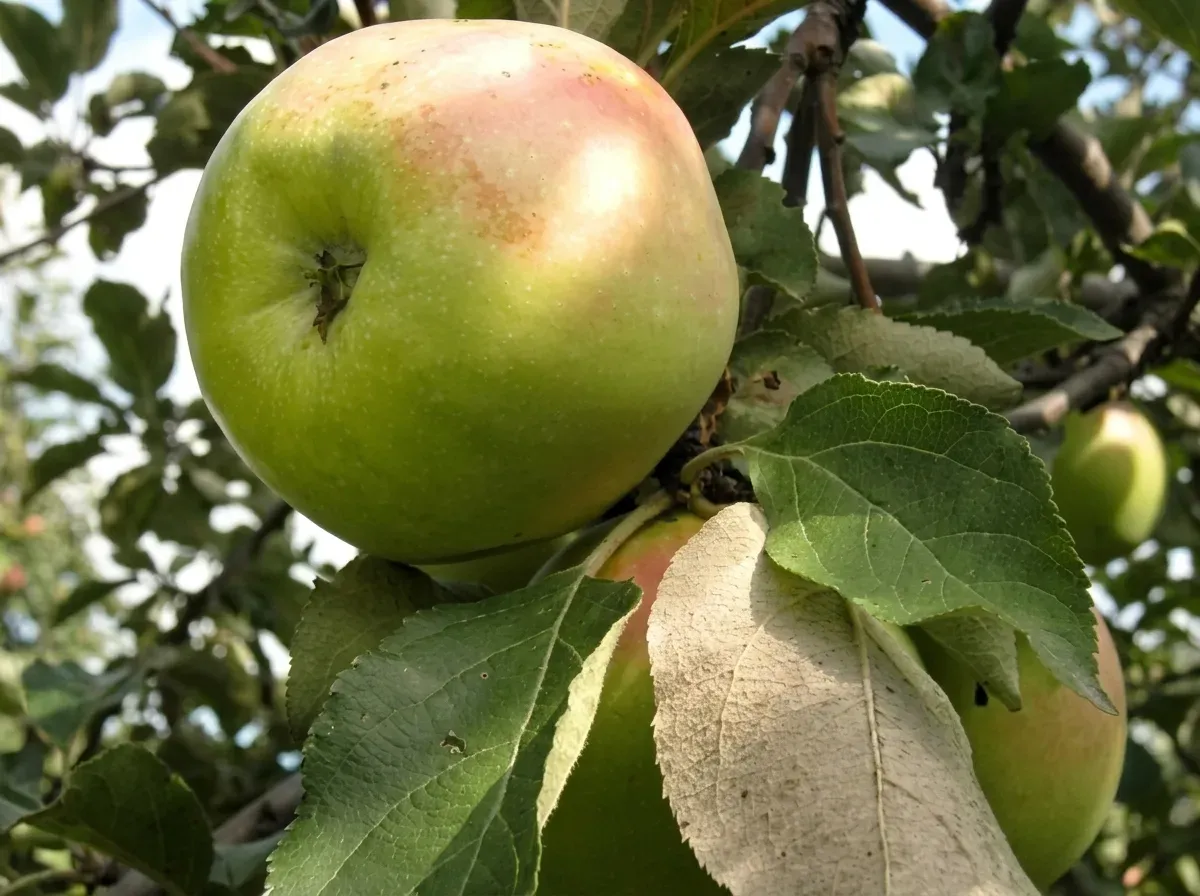
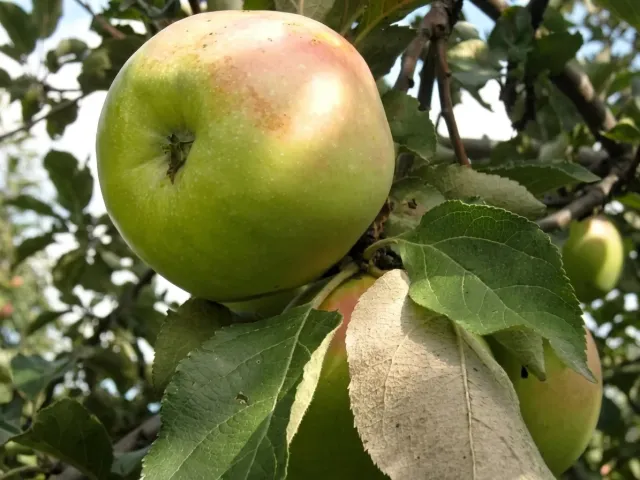
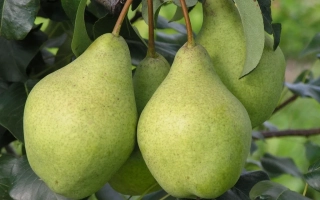
Fruits are above-average or large, one-dimensional, elongated, round-conical in shape, with blunt ridges, usually tapered at the apex. Fruit skin is strong, smooth, glossy, oily. Main color in the harvestable ripening stage is yellow-green, in the consumer ripening stage — golden-yellow. Skin coloration appears only on the sun-exposed side of the fruit as a diffuse, delicate blush. Subcutaneous dots are large, white, clearly visible. The calyx is narrow, acute-conical, without rusting. Fruit stem is medium or short. The receptacle is deep, bordered by large ridges. The calyx of most fruits is closed, while in larger fruits — half-open or open. The core is weakly expressed. Seed chambers are closed or slightly open. Seeds are small, ribbed, pointed, brown. Subcalyx tube is small, conical.
Fruit flesh is greenish-cream in color, very juicy, high quality, with a harmonious balance of sugar and acid, with a mild aroma. Average multi-year taste rating of fruits — 4.4–4.7 points. Appearance rating of fruits — 4.3 points. Chemical composition of fruits: total sugar — 9.5%, titratable acid — 0.52%, ascorbic acid content — 13.7 mg/100g, sum of P-active substances 194 mg/100g, pectin substances — 8.9%.
Harvestable ripeness of fruits in the Oryol region occurs in late September. Consumer period of fruits lasts from November to May.
Trees are cold-resistant, early-bearing, fruiting begins in the 4th–5th year, yields are stable year to year, which is advantageous compared to Antonovka ordinary, both in young and more mature trees. Average yield in the production test garden of VNIISPK over a long period amounted to 170 centners/ha. The variety is relatively resistant to scab.
Advantages of the variety: early bearing, sufficient cold resistance, high commercial and consumer qualities of fruits, their long storage life.
Disadvantages of the variety: large tree size. In soils deficient in calcium, fruits may be damaged by bitter pit.






Reviews · 2