


SKU #3425
·
1 594 views
Melba
Apple
User rating
1 vote100% positive reviews
No ratings yet — be the first.
Type of Sort
Summer apple variety
Tree; Growth Power
Medium-height
Tree; Canopy Shape
Round Canopy
Fruit; Fruit Shape
Round
Prices in stores
from0.01 €per seedling
pack from 0.73 € per 50 pcs
21 offer from 16 stores
Store offers · 21 from 16 stores
Prices are updated on loadLoading offers…
Available at: 1sad · AgronomVIP · Drevolaz · Edroses · GreenBrothers · GreenSteam · Плідник Круглик · Квіти Буковини · Олегів сад · Posadka · Profisad · Райська Долина · Райський Куточок · Розквітай · Sadco · Sadokshop
Aggregator catalog: prices are collected automatically from store websites, normalized by AI and converted at the current exchange rate. Before ordering, confirm the price and availability on the store's website. This block is not indexed by search engines — the data is loaded after the page opens.
About product
A Canadian variety with late-ripening fruit. Developed in 1898 at the Central Experimental Station in Ottawa (Canada) by sowing seeds of the McIntosh variety from open pollination; it has gained wide popularity in many regions of Russia. Due to its positive qualities, the variety is included in the State Register (regionally approved) in nearly all regions of Russia except the Northern, Ural, and…
Type of Sort
Summer apple variety
Tree; Growth Power
Medium-height
Tree; Canopy Shape
Round Canopy
Fruit; Fruit Shape
Round
Description
A Canadian variety with late-ripening fruit. Developed in 1898 at the Central Experimental Station in Ottawa (Canada) by sowing seeds of the McIntosh variety from open pollination; it has gained wide popularity in many regions of Russia. Due to its positive qualities, the variety is included in the State Register (regionally approved) in nearly all regions of Russia except the Northern, Ural, and Far Eastern regions.
Medium-sized trees with round crowns. Branches with brownish-orange bark. Mixed fruiting type, but the main mass of fruit on mature trees forms on spurs.
Medium-thick shoots, moderately hairy. Leaves elongated-oval, slightly curved, convex and inflated upward on strong shoots, light green, often with a yellowish tint. Leaf margins toothed. One-year-old plants are nearly straight, thick, with shiny light-cherry-colored bark and downward-hanging leaf margins.
Flowers large, buds white-pink with a purple tint, petals light pink, round, closed, slightly overlapping each other, stigmas below or at the level of the anthers.
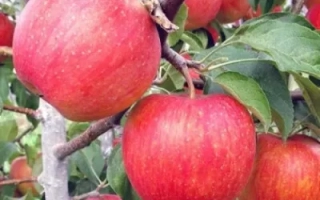
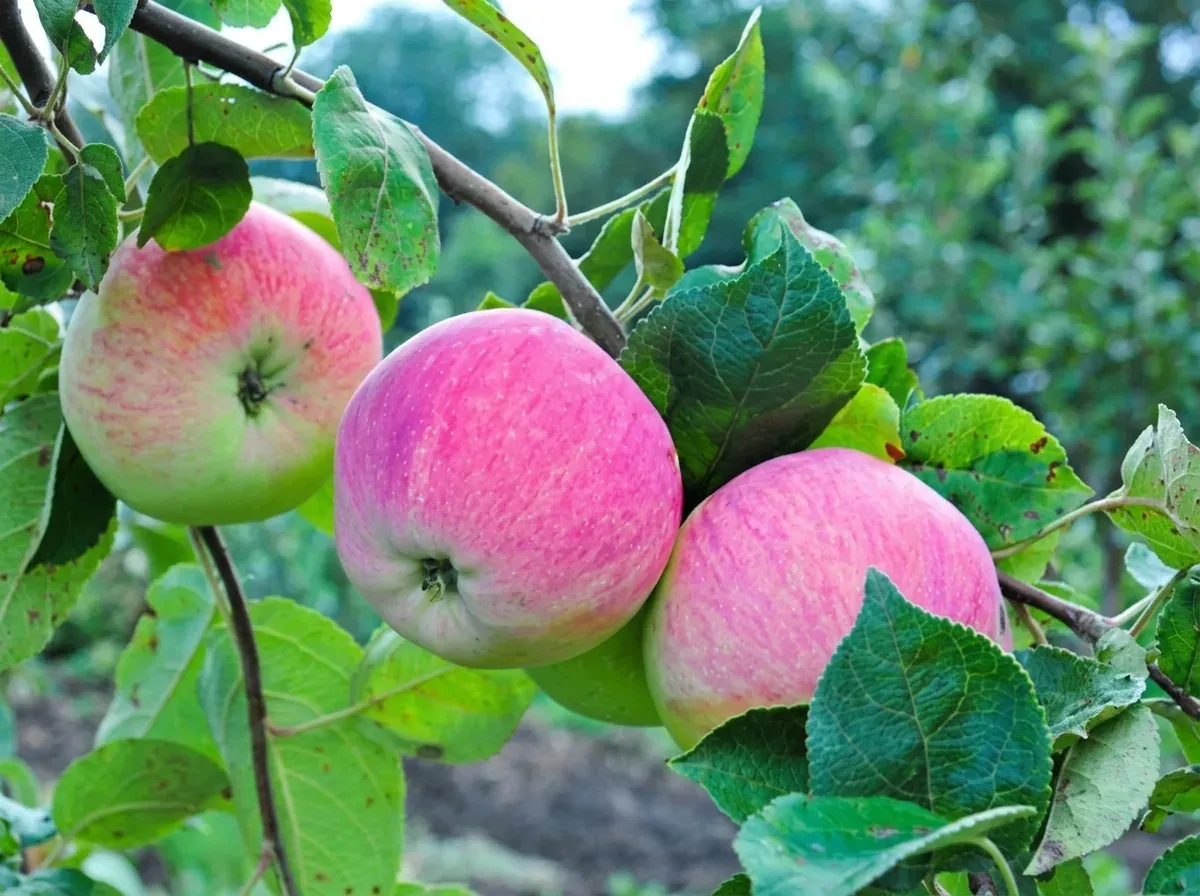
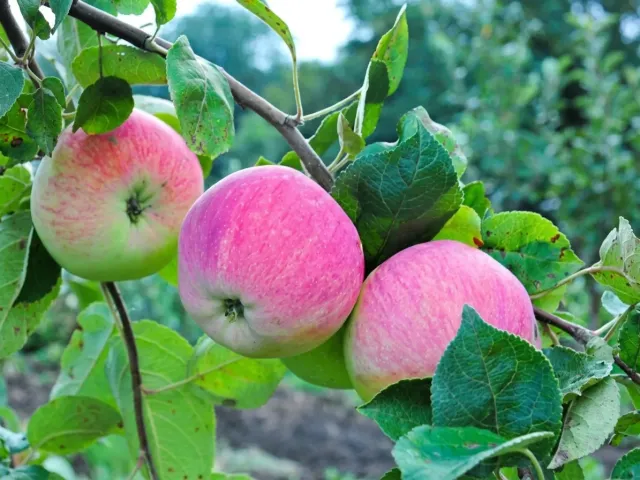
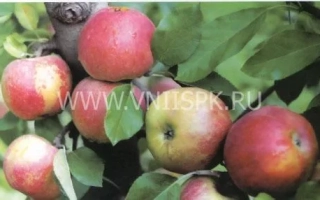
Fruit medium to above-medium size, flattened, round-conical shape, slightly ribbed. Maximum diameter closer to the base of the fruit. Skin smooth, tender, covered with a waxy coating. Main color light green, with a vivid red mottled blush covering about half the fruit surface. Under-skin dots white, medium-sized or small, clearly visible on the colored portion of the fruit. Calyx deep, medium width. Pedicel medium length, thin. Receptacle medium depth, narrow, wrinkled, calyx closed. Core medium size, shaped like a bulb. Seed chambers near the fruit apex, widely open into the central cavity. Seeds large, elongated, brown.
Flesh snow-white, tender, juicy, with a strong candy-like aroma, excellent sweet-tart flavor.
Fruit of the Melba variety is suitable for making compotes and juices. Chemical composition of the fruit: total sugars — 10.5%, titratable acids — 0.78%, ascorbic acid — 13.4 mg/100g, P-active substances — 297 mg/100g, pectic substances — 10.1%.
Harvesting ripeness occurs in the second half of August.
Fruit of this variety withstands transportation well and can be stored in refrigeration until November, sometimes even until January.
Very early-bearing variety. With good care, trees begin producing marketable fruit by the 4th-5th year after planting. High yield. At the VNIISPK orchard, over the first six years of fruiting (starting from the 6th year after planting) the average yield was 93 centners per hectare with trees spaced 8 x 3 meters. Mature trees spaced 7 x 7 meters produced even higher yields (120-180 centners per hectare). Young trees bear fruit annually, older ones — periodically.
Moderate winter hardiness. At the VNIISPK orchard, trees of the Melba variety planted in 1962 suffered significant damage from bark scorch on trunks and main branches after the harsh winter of 1968-1969. Resistance of fruit to scab is moderate. In some years, scab causes significant damage.
Advantages of the variety: high early-bearing capacity, high yield, good market and consumer qualities of fruit.
Disadvantages of the variety: susceptibility of fruit to scab, insufficient winter hardiness, tendency toward periodic fruiting.
Using Melba, over 20 new varieties have been developed, including Zavetnoe {[(Ranetka purpurovaya x Pepin shafranny) x Belfler-kitayka] x Melba} by the Siberian Institute of Horticulture named after M. A. Lisavenko, Rannee Alloe (Melba x Papировка) by VNIISPK, and Krasnoye Rannee (Melba x Vesna) by VNIIS named after I. V. Michurin. At the Ottawa Experimental Station (Canada), the variety Caravelle (Melba x Crimson Beauty) was developed. The variety Prima (USA), the first scab-immune variety (with the Vf gene), was also developed with the participation of Melba.
Video · 10 videos
Suggest a video →Crop & resistance
Crop
Disease resistance
Specifications hover over for a hint about the specification
| Type of Sort | |
|---|---|
| Tree; Growth Power | |
| Tree; Canopy Shape | |
| Fruit; Fruit Shape | |
| Fruit; Fruit mass | 100-150 grams |
| Fruit; Fruit Color (Base Color) | |
| Fruit; Blush (Blush Color) | |
|
Fruit; flesh color
Fruit; flesh color
Color of the fruit flesh. There are red, pink, yellow, and brown colors. |
|
| Fruit; Taste qualities | 4.5 stars |
| Cold Resistance | |
| Registration year | 1962 |
| Catalog | Catalog → Apple |
| Country | Ukraine |
Not yet комментариев. Be the first!
Alternatives
Apple saplings · similar varieties


See also
Often considered together with this variety




Recently viewed
Products you’ve viewed on this site
Reviews · 0