


SKU #3509
·
420 views
Rossoshanskoe Bagryanye
Apple
User rating
0 votes0% positive reviews
No ratings yet — be the first.
Type of Sort
Winter Apple Variety
Store offers · 2 from 2 stores
Prices are updated on loadLoading offers…
Available at: Divaland · Onlinesemena · Саженцы и черенки
Aggregator catalog: prices are collected automatically from store websites, normalized by AI and converted at the current exchange rate. Before ordering, confirm the price and availability on the store's website. This block is not indexed by search engines — the data is loaded after the page opens.
About product

Early winter variety selected at the Rossoshanskaya Zonal Experimental Station for fruit growing. Developed by M. M. Ulyanichyev from crossing 'Welsh' with 'Renet Simirenko'. Low popularity, mainly in Voronezh Oblast. Approved for State Testing in 1986. Trees range from medium to large. Young crown is narrowly pyramidal, mature crown is broadly pyramidal, sparse, medium foliage. Bark of trunk…
Type of Sort
Winter Apple Variety
Description
Early winter variety selected at the Rossoshanskaya Zonal Experimental Station for fruit growing. Developed by M. M. Ulyanichyev from crossing 'Welsh' with 'Renet Simirenko'. Low popularity, mainly in Voronezh Oblast. Approved for State Testing in 1986.
Trees range from medium to large. Young crown is narrowly pyramidal, mature crown is broadly pyramidal, sparse, medium foliage. Bark of trunk is gray-brown, branches are greenish-brown. Skeletal branch arrangement is inclined-vertical, gradually becoming horizontal with age. Weak shoot-forming ability, fruiting primarily in ring-shaped clusters on 2-3-year-old and older wood (spur type).
Shoots are reddish-brown, straight, medium length and thickness, round in cross-section, slightly hairy. Buds are medium-sized, inconspicuous. Buds are pressed, triangular, with hairy scales.
Leaves are positioned at acute angles to shoots, medium-large, broad, nearly round, with rounded base and short, weakly twisted apex. Toothed margin is coarse-toothed, green coloration. Blade is slightly folded upward and slightly curved downward along midrib, edges sometimes slightly wavy, leathery texture. Surface smooth, matte, underside slightly hairy, upper side hairless. Petiole medium length and thickness.
Flowers are arranged in umbellate inflorescences, medium size, cup-shaped, pinkish, fragrant, moderate quantity. Petals are egg-shaped, stigmas are positioned at the same level as anthers.
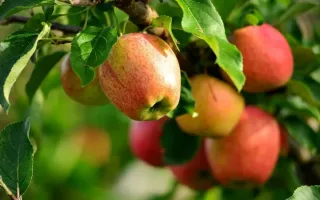
Fruits are above-average, average weight 160g, maximum 240g, conical, regular shape, wide ribbed. At consumer ripeness, main color is greenish-yellow, covering most surface, intense, blurred-striped red. Numerous, medium-sized, gray, clearly visible lenticels. Fruit stalk is short, medium thickness. Calyx tube is medium depth and width, plate is deep, narrow, slightly ribbed. Calyx is half-open. Core is large, bulbous. Chambers are open; subcalyx tube is short, conical. Seeds are large, round, light-brown.
Flesh is creamy, medium density, fine-grained, juicy, tender, slightly acidic-sweet, with moderate aroma. Fruit appearance is very attractive (4.7 points), flavor excellent (4.5 points). Chemical composition of fruits: dry matter content — 14.8%, sugars — 11.7%, titratable acid — 0.45%, ascorbic acid — 8.9 mg/100g.
Variety belongs to the medium-early winter group. Maximum storage life is 120 days. Fruit drop is absent. Transportability of fresh fruits and fruit quality are high. Fruit quality belongs to dessert varieties.
Enters fruiting stage on 6-7 years after grafting in nursery. High yield, comparable to control varieties 'Rossoshanskoe Ploskatoe' and 'Severny Sinap'.
Winter hardiness of tree is high. In the severe winter of 1978-1979 at -32°C, no frost damage was observed. In 1999, at temperature drop to -6°C during mass flowering (May 6-7), all flowers were killed, no harvest occurred. In 1982 during epiphytotic disease, variety showed high resistance to scab.
Advantages of variety: high ecological adaptability, including to diseases, high yield and fruit quality.
Disadvantages: short fruit consumption period.
Video · 2 videos
Suggest a video →Crop & resistance
Crop
Disease resistance
Specifications
| Type of Sort | |
|---|---|
| Catalog | Catalog → Apple |
Not yet комментариев. Be the first!
Alternatives
Apple saplings · similar varieties


See also
Often considered together with this variety





Recently viewed
Products you’ve viewed on this site
Reviews · 0