Late-winter variety. Obtained at the VNIIS named after I. V. Michurin from seeds of the 'Kandil-Chinese' variety through open pollination. Author: S. I. Isaev. Approved for cultivation in the Central Chernozem, Middle and Lower Volga regions, and in a trellised form — in the Eastern Siberian region. Has a wide distribution area, both in commercial plantations and on dacha plots.
Large-sized tree, vigorous, with a wide-pyramidal, moderately dense crown composed of several strong scaffold branches and numerous thin lateral branches covered with multi-year fruit-bearing wood. Bark on the trunk and scaffold branches is gray.
Shoots are straight, medium thickness, slightly curved, brownish, moderately hairy. Buds are few and small. Fruit-bearing type (see illustration) is mixed: on flower clusters, catkins, twigs, and one-year shoots. In the nursery, saplings have a gray-cherry color with small white buds. Leaves are dark green, medium-sized, broad, elongated, egg-shaped, heavily hairy, shiny, with a grayish tint. Leaf margin is uplifted. Petiole is short, medium thickness, positioned at a 45° angle to the leaf blade. Toothed margin is serrated-lobed — with segments of 2 or more teeth. Bracts are elongated, medium width.
Flowers are large, with pink petals. Buds are red.
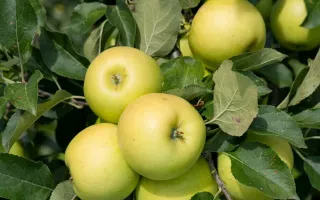
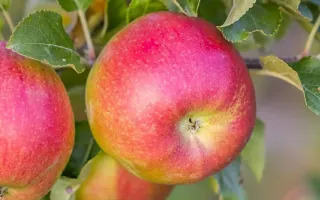
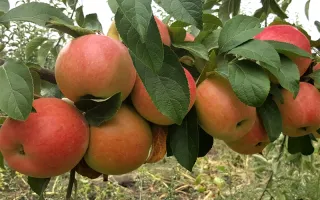
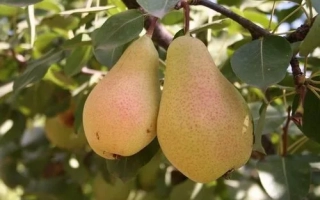
Fruits are medium-sized (average weight 120 g), rounded-conical or cup-shaped. Skin is smooth, becoming oily when stored. Main color is yellowish-green, with a reddish-brown blush on the sun-exposed side of the fruit. Subcutaneous spots are light, numerous, large — clearly visible. Core is large, elongated-lily-like. Seeds are above-average size, elongated-egg-shaped, brown. Peduncle is medium length and thickness. Calyx tube is narrow, medium depth, smooth. Calyx is closed. Subcalyx tube is medium length and width. Receptacle is small, wide, ribbed.
Flesh is white or slightly greenish, fine-grained, slightly acidic-sweet, medium density, juicy, refreshing, with a mild spice. Fruits contain: dry matter — 15.8%, sugars — 11.0%, ascorbic acid — 11.5 mg/100g, total P-active substances — 102 mg/100g.
In terms of ripening and consumption, Northern Synap belongs to the late-winter varieties. Harvesting maturity occurs in early October. Do not rush to harvest — only fully ripe fruits have high taste quality, attractive appearance, and good storage capability in fruit storage facilities.
Fruits have high storability, but if harvested too early, they may spoil. Optimal refrigerator temperature is 0+1°C. Fresh consumption ends in May.
Fruits are suitable for various types of technical processing — compotes, jams, juices, dried fruits.
Trees are distinguished by early fruiting and high yield. Begin fruiting on the 5th-8th year after planting in orchards, on dwarf rootstocks (62-396) already on the second year. On dwarf rootstocks, the fruit quality and taste noticeably improve. After 20 years, abundant yields alternate with weak or average ones. In the absence of regular pruning and proper care, periodicity occurs and fruit quality significantly declines. The variety is partially self-fertile. Yield is significantly higher in mixed plantings.
The variety is winter-hardy, slightly less than Antonovka ordinary. Drought resistance is average. Resistance to powdery mildew and scab — average.
Advantages of the variety: winter hardiness, early fruiting, high yield of trees, good taste when fruits mature, outstanding storability of fruits.
Disadvantages of the variety: unevenly sized fruits, reduced commercial quality with heavy yields, large tree size, late onset of harvesting maturity.








Reviews · 1