



SKU #3542
·
2 665 views
Spartan
Apple
User rating
1 vote100% positive reviews
No ratings yet — be the first.
Type of Sort
Winter Apple Variety
Tree; Growth Power
Medium-height
Tree; Canopy Shape
Broad-pyramidal crown
Fruit; Fruit Shape
Round-cylindrical
Store offers · 15 from 13 stores
Prices are updated on loadLoading offers…
Available at: 1sad · Agro-market · AgronomVIP · Чудеса Саду · GreenBrothers · Квіти Буковини · Литинсад · Лизгард · Олегів сад · Плодосад · Sadovnik-sam · Сади Буковини · Семена Буковины
Aggregator catalog: prices are collected automatically from store websites, normalized by AI and converted at the current exchange rate. Before ordering, confirm the price and availability on the store's website. This block is not indexed by search engines — the data is loaded after the page opens.
About product

A Canadian variety with winter-ripening fruit, developed in 1926 at the experimental station in Summerland from a cross between McIntosh × Yellow Newtown. Approved for cultivation. Moderate-growing trees with rounded crowns and typically a leaning central leader. Fruit set is concentrated, primarily on spurs. Shoots are curved, dark-cherry-colored, with strong pubescence. Leaves are medium…
Type of Sort
Winter Apple Variety
Tree; Growth Power
Medium-height
Tree; Canopy Shape
Broad-pyramidal crown
Fruit; Fruit Shape
Round-cylindrical
Description
A Canadian variety with winter-ripening fruit, developed in 1926 at the experimental station in Summerland from a cross between McIntosh × Yellow Newtown. Approved for cultivation.
Moderate-growing trees with rounded crowns and typically a leaning central leader. Fruit set is concentrated, primarily on spurs.
Shoots are curved, dark-cherry-colored, with strong pubescence. Leaves are medium or small, dark green, leathery, glossy, broad, nearly round in cross-section, with a small, spirally twisted tip and heart-shaped base. Leaf surface is strongly wrinkled, blade is curved at the base. Leaf margins are serrated-ciliate, with slightly flattened tips, slightly raised on upper leaves. Petioles are medium-length, slender, with anthocyanic coloring, and small sickle-shaped stipules. Buds are small, conical, tightly pressed.
One-year seedlings in the nursery are small, with a slightly curved, strongly pubescent stem, dark-cherry bark, and no lateral branches.
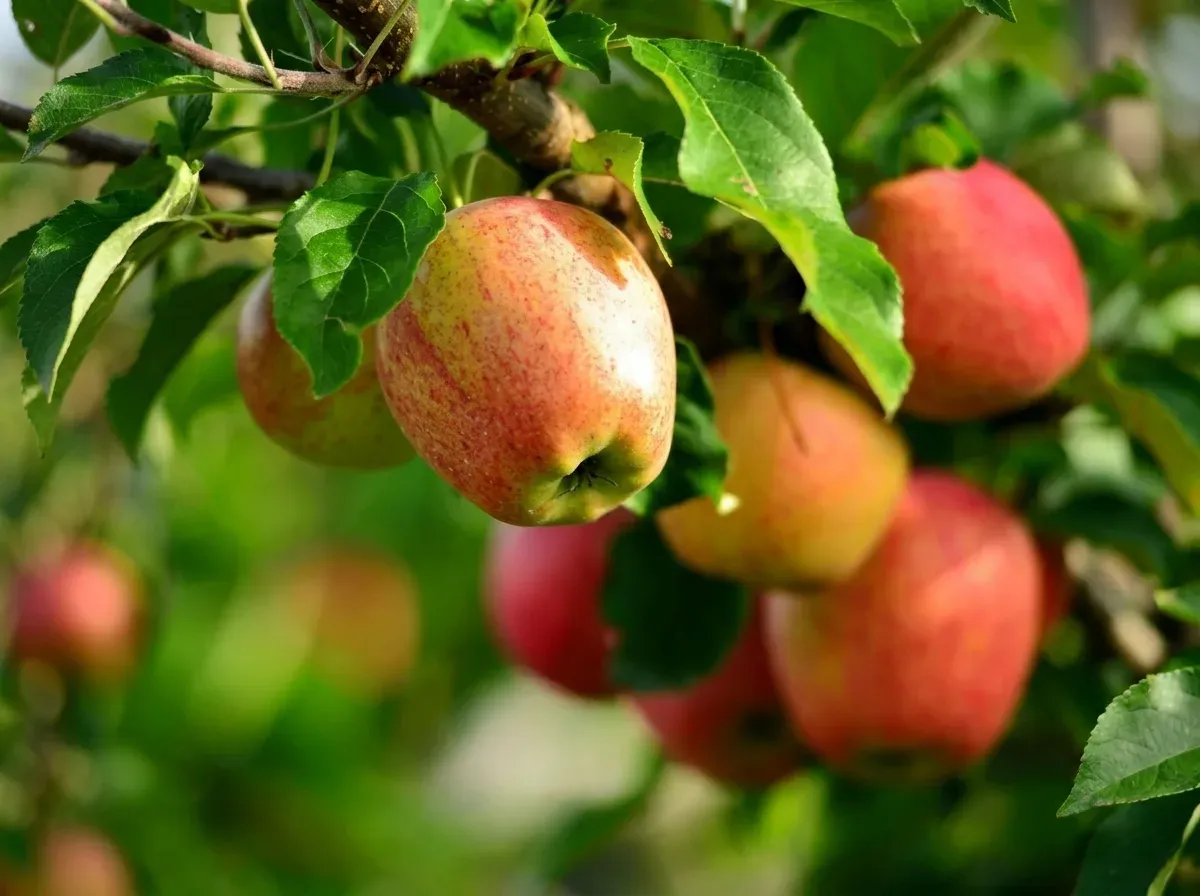
Fruit are medium-sized, flattened-round or round-conical, slightly ribbed toward the apex. Main color is light-yellow, with a covering that covers nearly the entire fruit surface — an intense purplish-red blush. A strong waxy bloom gives the fruit a purplish appearance. The pedicel of central fruits is small and thick, while others are thinner and longer. The calyx is shallow. The receptacle is small, wrinkled, often not colored, remaining greenish-yellow. The calyx is small, closed, with tightly closed conical sepals, located in a slightly ribbed, medium-sized receptacle. The seed cavity is bulb-shaped, small, with small seed chambers slightly open at the bottom into the central cavity. The subcalyx tube is conical.
Flesh is white, firm, juicy, sweet, without sour taste, aromatic, and of good flavor. Chemical composition of fruit: total sugars — 10.6%, titratable acids — 0.32%, ascorbic acid — 4.6 mg/100g, P-active substances — 160.2 mg/100g, pectin substances — 11.1%.
Fruit ripening in the Oryol region occurs at the end of September.
Fruit hold firmly on the tree and do not drop during ripening. In the refrigerator, fruit can be stored until March–April.
The variety is characterized by high early fruiting and good yield, but is not sufficiently winter-hardy in central regions of the Middle Belt of Russia, and is resistant to scab.
Advantages of the variety: early fruiting, good yield, resistance to scab, high fruit flavor quality, long storage life of fruit.
Disadvantages of the variety: insufficient winter hardiness of the tree, fruit becoming smaller with tree age and with insufficient pruning.
Video · 11 videos
Suggest a video →Crop & resistance
Crop
Disease resistance
Specifications hover over for a hint about the specification
| Type of Sort | |
|---|---|
| Tree; Growth Power | |
| Tree; Canopy Shape | |
| Fruit; Fruit Shape | |
| Fruit; Fruit mass | 100-150 grams |
| Fruit; Fruit Color (Base Color) | |
| Fruit; Blush (Blush Color) | |
|
Fruit; flesh color
Fruit; flesh color
Color of the fruit flesh. There are red, pink, yellow, and brown colors. |
|
| Fruit; Taste qualities | 4.0 stars |
| Cold Resistance | |
| Registration year | 1986 |
| Catalog | Catalog → Apple |
| Country | Ukraine |
Not yet комментариев. Be the first!
Alternatives
Apple saplings · similar varieties


See also
Often considered together with this variety





Recently viewed
Products you’ve viewed on this site
Reviews · 0