
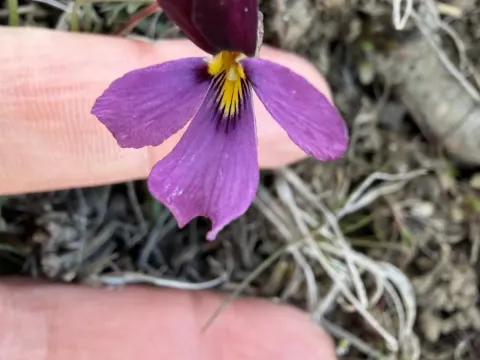
Three-veined violet
Viola trinervata
The three-veined violet (Viola trinervata) is a herbaceous perennial plant belonging to the Violaceae family. In its natural habitat, the species is found in the western regions of North America, where it typically inhabits dry mountain slopes and open rocky terrain.
What the section contains
Three-veined violet
The plant possesses a specific biology: it forms a compact rosette of narrow, lanceolate leaves featuring three distinct veins, which is the origin of its scientific name. The stems are generally short, an evolutionary adaptation that allows the violet to thrive in exposed high-altitude environments.
For successful cultivation of Viola trinervata, well-drained, sandy or gravelly soils with low organic content are required. The crop is extremely sensitive to waterlogging, which rapidly leads to root rot and the death of the plant.
This species has a high requirement for direct, intense solar radiation. Under conditions of insufficient light, the violet loses its compact ornamental form, stems become elongated, and flowering intensity drops significantly, making site selection a critical agricultural factor.
The temperature regime should ideally match a moderate continental climate with a distinct dormant period during winter. While the plant is hardy, it struggles with rapid temperature fluctuations combined with high ambient humidity during the autumn season.
The primary threats to the three-veined violet are fungal diseases caused by poor soil moisture management. Powdery mildew is the most frequent issue, often manifesting as a white film on leaves when plants are grown in overcrowded conditions.
Root rot diseases, triggered by pathogens like Pythium and Phytophthora, pose the most significant risk. These pathogens proliferate rapidly in overwatered soil, making strict irrigation control the most effective preventative strategy for this species.
Common pests include aphids and spider mites, which feed on the sap of young leaves and flower buds. Routine visual inspection of the planting site is essential to detect pest colonies in the early stages before they can cause severe economic or aesthetic damage.
Slugs and snails can cause significant mechanical damage to the foliage, particularly during wet seasons. Surrounding the plants with gravel or stone mulch serves as an effective physical barrier that restricts mollusk movement and helps keep the root collar dry.
Maintaining a clean cultivation area by removing dead plant debris is crucial to prevent the onset and spread of diseases. Utilizing biological fungicides as a proactive treatment helps sustain plant health without relying on heavy chemical intervention.