
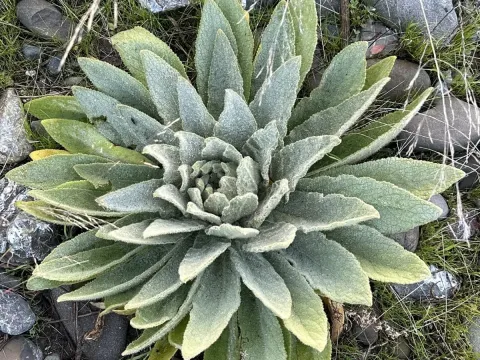
Mullein
Verbascum L.
Mullein (Verbascum L.) seeds are typically sown in spring, during April or May, once the soil has warmed to at least 10–12 degrees Celsius. Autumn sowing in October is also possible, as it allows for natural seed stratification and earlier germination the following year.
What the section contains
 Chaix's mullein
Verbascum chaixii Vill.
Chaix's mullein
Verbascum chaixii Vill.
 Cretan mullein
Verbascum creticum Cav.
Cretan mullein
Verbascum creticum Cav.
 Dense-flowered mullein
Verbascum phlomoides L.
Dense-flowered mullein
Verbascum phlomoides L.
 Golden mullein
Verbascum epixanthinum Boiss. & Heldr.
Golden mullein
Verbascum epixanthinum Boiss. & Heldr.
 Great mullein
Verbascum densiflorum Bertol.
Great mullein
Verbascum densiflorum Bertol.
 Great mullein
Verbascum thapsus L.
Great mullein
Verbascum thapsus L.
 Hybrid Mullein
Verbascum epixanthinum x Verbascum phoeniceum L.
Hybrid mullein
Verbascum x hybridum Brot.
Hybrid Mullein
Verbascum epixanthinum x Verbascum phoeniceum L.
Hybrid mullein
Verbascum x hybridum Brot.
 Hybrid Mullein
Verbascum phoeniceum x Verbascum pyramidatum
Hybrid Mullein
Verbascum phoeniceum x Verbascum pyramidatum
 Moth mullein
Verbascum blattaria L.
Moth mullein
Verbascum blattaria L.
 Olympian mullein
Verbascum olympicum Boiss.
Olympian mullein
Verbascum olympicum Boiss.
 Purple mullein
Verbascum phoeniceum L.
Purple mullein
Verbascum phoeniceum L.
 Pyramid mullein
Verbascum pyramidatum M. Bieb.
Pyramid mullein
Verbascum pyramidatum M. Bieb.
 Silver mullein
Verbascum bombyciferum Boiss.
Silver mullein
Verbascum bombyciferum Boiss.
 Twiggy mullein
Verbascum virgatum Stokes
Verbascum luridiflorum
Verbascum luridiflorum Hub.-Mor.
Twiggy mullein
Verbascum virgatum Stokes
Verbascum luridiflorum
Verbascum luridiflorum Hub.-Mor.
Mullein
The seeds are extremely small, requiring shallow sowing at a depth of no more than 0.5–1 centimeter. To ensure even distribution, seeds are often mixed with sand or wood ash in a 1:10 ratio before broadcasting.
When using a seedling method, seeds are sown in trays during March. Seedlings usually emerge within 14–20 days and should be pricked out when the first two true leaves have developed.
The optimal planting density is 40–50 centimeters between rows and approximately 30 centimeters between individual plants. This spacing provides enough room for the development of the basal rosette of leaves.
After sowing, it is recommended to gently firm the soil surface to ensure good seed-to-soil contact, although irrigation should be performed using a fine mist or sprinkler to prevent washing away the small seeds.
Mullein belongs to the Scrophulariaceae family and is known for being a low-maintenance, hardy plant. It thrives in open, sunny locations, as shading causes the stems to become weak and reduces the density of the blooms.
The plant is not overly demanding regarding soil type, but it performs best in light, sandy or loamy soils with excellent drainage. Heavy clay soils that tend to waterlog are detrimental to the root system.
The plant is highly drought-tolerant due to the fine hairs on its leaves, which reduce transpiration. Excessive watering should be avoided, as it can easily lead to root rot at the base of the plant.
Native to temperate zones of Europe, Asia, and the Mediterranean, the plant is well-adapted to fluctuating temperatures and typically does not require winter protection in most climates.
While mullein responds well to mineral fertilizers, avoiding excessive nitrogen is crucial, as it promotes aggressive leafy growth at the expense of flower quality for medicinal use.
The primary pests of mullein include various caterpillar species and moths that feed on the foliage and flower buds. For minor infestations, hand-picking the insects is effective, while bio-insecticides are suitable for larger populations.
In conditions of high humidity or poor air circulation, plants may suffer from powdery mildew, manifesting as a white fungal coating on the leaves. Prevention includes maintaining proper spacing and avoiding overhead watering.
Root rot is a major threat caused by poor agricultural practices and waterlogged soil. Infected plants must be removed immediately, along with the surrounding soil, to prevent the spread of the pathogen.
Phyllosticta leaf spot can occasionally affect the plant, causing dark lesions on the foliage. Control measures involve removing damaged leaves and applying copper-based fungicides if necessary.
To deter aphids and other sap-sucking pests, organic infusions made from garlic or tobacco dust can be used, which is particularly beneficial for plants grown for medicinal herbal use.
The harvesting of medicinal flower parts occurs during the peak flowering season, typically between June and August. Flowers should be picked by hand during dry, sunny weather, as moisture causes them to turn black and lose potency.
It is important to remember that each individual flower lasts only one day, necessitating daily harvests throughout the flowering period. Once gathered, inflorescences should be processed immediately to prevent oxidation.
Drying is performed in specialized dehydrators at temperatures between 40–50 degrees Celsius or in well-ventilated, shaded areas by spreading the flowers in thin layers on paper or cloth.
Finished raw material should retain its vibrant natural yellow color and a distinct honey-like scent. Properly dried flowers should be crisp and crumble easily when pressed between fingers.
Dried mullein must be stored in dry, light-protected locations within airtight containers, as the material is hygroscopic and can easily absorb environmental moisture, leading to mold growth.