
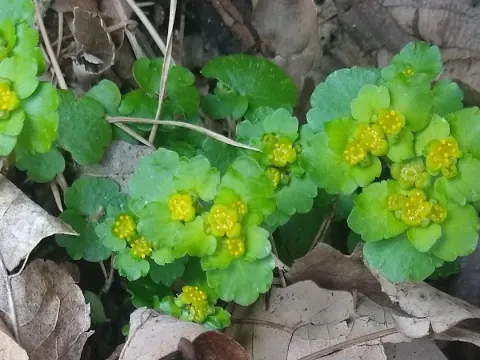
Golden-saxifrage
Chrysosplenium
Golden-saxifrage (Chrysosplenium) is a genus of low-growing perennial herbs belonging to the Saxifragaceae family. The plants are naturally adapted to cool, damp environments, frequently appearing in shady woodland areas and along the margins of mountain springs and streams.
What the section contains
 Alternate-leaved golden-saxifrage
Chrysosplenium alternifolium
Alternate-leaved golden-saxifrage
Chrysosplenium alternifolium
 Chinese golden-saxifrage
Chrysosplenium sinicum
Chinese golden-saxifrage
Chrysosplenium sinicum
 Chrysosplenium pilosum
Chrysosplenium pilosum
Chrysosplenium pilosum
 Fleshy golden-saxifrage
Chrysosplenium carnosum
Fleshy golden-saxifrage
Chrysosplenium carnosum
 Golden Saxifrage
Chrysosplenium macrostemon
Golden Saxifrage
Chrysosplenium macrostemon
 Golden saxifrage
Chrysosplenium album
Golden saxifrage
Chrysosplenium album
 Golden Saxifrage
Chrysosplenium flagelliferum
Golden Saxifrage
Chrysosplenium flagelliferum
 Golden saxifrage
Chrysosplenium ramosum
Golden saxifrage
Chrysosplenium ramosum
 Gray's golden-saxifrage
Chrysosplenium grayanum
Gray's golden-saxifrage
Chrysosplenium grayanum
 Griffith's golden-saxifrage
Chrysosplenium griffithii
Griffith's golden-saxifrage
Chrysosplenium griffithii
 Japanese golden saxifrage
Chrysosplenium japonicum
Japanese golden saxifrage
Chrysosplenium japonicum
 Nepal golden-saxifrage
Chrysosplenium nepalense
Nepal golden-saxifrage
Chrysosplenium nepalense
 Opposite-leaved golden-saxifrage
Chrysosplenium oppositifolium
Opposite-leaved golden-saxifrage
Chrysosplenium oppositifolium
 Woolly golden-saxifrage
Chrysosplenium lanuginosum
Woolly golden-saxifrage
Chrysosplenium lanuginosum
Golden-saxifrage
Botanically, these plants are characterized by their creeping stoloniferous stems and small, often yellowish bracts that surround the flowers, giving them a bright appearance in early spring. They are highly appreciated in horticultural practices for their ability to thrive in deep shade where most other plants fail.
Agricultural requirements focus heavily on soil moisture management. The species requires soil that is rich in organic matter and remains consistently moist throughout the growing season. It thrives in soils with neutral to slightly acidic pH levels, reflecting its native forest habitat.
Cultivation should prioritize site selection in sheltered, shaded spots to prevent the leaves from scorching. Since it is a surface-rooting plant, it functions well as a green mulch, effectively protecting the soil surface from erosion and reducing competition from invasive weed species.
Propagation is most efficiently achieved through division of the creeping mats or by collecting seeds. When growing from seeds, cold stratification is essential to break dormancy, ensuring a high germination rate and strong seedling development during the first year of life.
The primary threats to golden-saxifrage are environmental rather than pathogenic. Water stress, specifically drought, is the most common cause of crop failure. Without consistent hydration, the plant quickly loses its structural integrity and vitality.
Mollusks, including slugs and snails, are the most significant biological pests. In damp, shaded conditions, these organisms can cause severe damage to the foliage, necessitating either manual removal or the application of safe, iron-phosphate-based baits to protect the patch.
Fungal issues, such as leaf spot or damping-off, may occur if the planting density is too high, preventing adequate airflow between individual plants. Maintaining proper spacing and removing debris from the base of the plant helps mitigate these risks significantly.
Root rot remains a concern in areas with heavy, clay-based soils that do not drain effectively. Even though the plant loves moisture, it does not tolerate stagnant water, which suffocates the roots and encourages the proliferation of opportunistic anaerobic bacteria.
Integrated pest management protocols suggest monitoring the population of slugs during early spring emergence. Keeping the surrounding area clear of excess decaying matter helps to keep pest populations at a manageable level without resorting to harsh chemical interventions.