
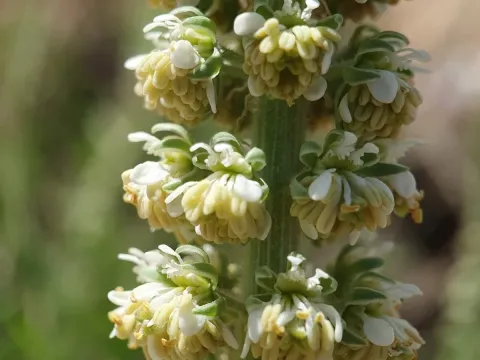
Reseda villosa
Reseda villosa
Reseda villosa is a notable species within the Resedaceae family, recognized for its adaptation to arid climates. Originally native to Mediterranean and North African regions, this plant has evolved to thrive in environments with limited water availability and rocky or sandy soil structures.
What the section contains
Reseda villosa
The botanical profile of the plant features distinct pubescence on the stems, which is the primary trait distinguishing it within the genus. It develops a deep taproot system, facilitating survival in drought-prone landscapes while supporting a rosette of foliage and upright racemes of flowers.
Regarding climatic requirements, the crop demands full sun exposure throughout the growing season. It performs best in regions where high temperatures are prevalent, as the plant is specifically adapted to maximize photosynthesis under high irradiance levels with minimal thermal stress.
Soil management is critical, as Reseda villosa requires excellent drainage to prevent root diseases. Sandy, calcareous, or gravelly soils are preferred for commercial cultivation. The substrate should be maintained at a neutral to slightly alkaline pH to ensure optimal nutrient uptake and plant vigor.
Agronomic practices for this species focus on row spacing that promotes airflow and soil warming. While the plant is inherently hardy, supplementary irrigation should be managed with precision to avoid saturation, especially during the seedling stage or after rainfall events.
The main threats to successful cultivation involve pathogens that thrive in humid environments. Powdery mildew is the most common fungal issue, often occurring when plant density is too high or when ventilation within the crop canopy is insufficient during cooler, wet weather.
Insects, particularly lepidopteran larvae, pose a significant risk to the foliage during the vegetative stage. Farmers should implement integrated pest management (IPM) strategies, which include monitoring pheromone traps and inspecting the undersides of leaves for egg clusters.
Root rot and soil-borne pathogens can devastate stands if drainage is compromised. To mitigate this risk, it is recommended to implement a robust crop rotation schedule and avoid planting in fields that have a history of drainage issues or heavy, compacted soil types.
Weed control is essential, especially in the early stages of development, as Reseda villosa can be outcompeted by aggressive grasses and broadleaf weeds. Mechanical weeding should be performed carefully to avoid disturbing the sensitive shallow root collars of the young plants.
Protecting the crop also involves assessing the surrounding ecosystem to ensure that aphid populations remain under control. Aphids can act as vectors for viral diseases, which, once present in a field, can be difficult to manage without removing infected plants.