
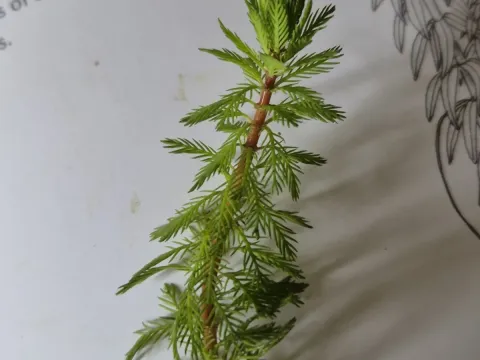
Red-stemmed water milfoil
Myriophyllum rubricaule
Propagation of the red-stemmed water milfoil is primarily achieved through stem cuttings in controlled aquatic environments.
What the section contains
Red-stemmed water milfoil
Spring is considered the optimal time for propagation, coinciding with the natural increase in day length and ambient light intensity.
Healthy stems should be cut into segments of approximately 10 to 15 centimeters and placed into a nutrient-rich sandy or loamy substrate.
In industrial aquaculture settings, rooting is often enhanced by supplemental CO2 injection and steady water flow during the initial phase.
Ensuring proper spacing between cuttings allows for uniform growth and reduces the competition for light among developing young shoots.
This species belongs to the Haloragaceae family and thrives in conditions that mimic its native nutrient-rich, slow-moving water habitats.
Temperature control is essential, with an ideal range of 20 to 26 degrees Celsius being necessary for robust physiological performance.
High-intensity light is a non-negotiable requirement to maintain the characteristic deep red coloration of the main stems.
The substrate should be rich in iron and other micronutrients, which are vital for the plant's metabolic processes and pigment development.
Regular water monitoring for pH and carbonate hardness is recommended to prevent chemical stress and stunted growth patterns.
The most significant threat to the culture is the proliferation of filamentous algae, which can quickly smother the delicate leaf structures.
Poor water quality can lead to fungal outbreaks, often manifesting as softening or localized rot along the vascular stem tissue.
Pests, particularly aquatic mollusks, can cause severe mechanical damage by grazing on the soft, feathery foliage of the plant.
Nutrient imbalances, particularly iron deficiency, lead to chlorosis and the loss of the plant's signature reddish appearance.
Implementing an integrated pest management strategy including manual inspection and water quality stabilization is crucial for high yields.
The harvest consists of systematic pruning, which serves both to collect marketable product and to stimulate dense branching.
Harvested stems must be processed immediately by cleaning and removing damaged leaves to ensure high-quality presentation for buyers.
Grading is performed based on stem length, pigmentation intensity, and the overall density of the whorled leaf structures.
Products intended for distribution are kept in high-humidity environments to maintain turgor pressure during transit to retail locations.
Continuous harvesting cycles are sustainable if the mother plants are adequately supplemented with fertilizers and high-intensity illumination.