
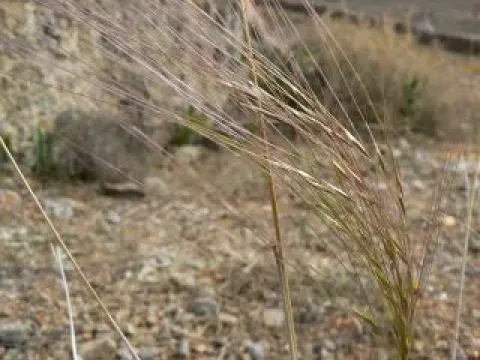
Stipa parviflora
Stipa parviflora
Stipa parviflora is a resilient perennial species belonging to the Poaceae family. Known for its adaptability, this grass serves as a vital component of steppe ecosystems and has potential for use in sustainable agricultural projects.
What the section contains
Stipa parviflora
The sowing period is primarily scheduled for early spring, allowing the seeds to establish themselves during the peak of soil moisture availability. Precision sowing helps optimize the distribution of seeds across the field, ensuring uniform development.
The plant exhibits a slow growth habit during its first year, prioritizing root development to reach deeper water reservoirs. This biological strategy is essential for survival in arid environments and requires weed-free seedbeds for optimal establishment.
In practice, the seeds benefit from being drilled at a shallow depth. The unique structure of the Stipa awn acts as a self-burying mechanism, pulling the seed into the soil through hygroscopic movements triggered by changing humidity levels.
Strategic planting ensures that the clumps have enough space to expand. When used for pasture restoration, early sowing is critical to minimize the competition from faster-growing annual weeds.
Stipa parviflora thrives in well-drained, sandy, or rocky soils with neutral to slightly alkaline pH levels. It is highly intolerant to waterlogging, which can cause root rot and rapid loss of stand density within the field.
The species is exceptionally drought-tolerant. Its narrow leaves and deep, extensive root system allow it to survive periods of extreme heat and prolonged precipitation deficits that would be fatal to most commercial forage crops.
Light availability is paramount for this species. As a true steppe plant, it requires full sun exposure to produce healthy, reproductive tillers. Any shade from surrounding trees or structures significantly reduces biomass production and flowering.
Climatic requirements are broad, covering continental regions with high seasonal temperature fluctuations. The plant is perfectly adapted to withstand both harsh winters and intense summer heat without the need for additional protection.
Soil fertility is not a primary concern for this species, as it is evolved to exploit low-nutrient habitats. It performs well on eroded or reclaimed lands where other vegetation might struggle to survive due to poor soil quality.
Stipa parviflora exhibits a strong natural resistance to most common cereal diseases. Its unique physiology and environment make it an unappealing host for major agricultural pathogens such as mildew or various rusts.
While disease pressure is low, maintaining appropriate plant spacing is essential to ensure adequate airflow. High humidity trapped within overly dense clumps can occasionally foster minor fungal outbreaks on the foliage.
Pest risks are similarly low compared to intensive crops. Some soil-dwelling insects may feed on roots, but the plant’s robust structure generally allows it to recover without the need for chemical intervention.
Seed-eating birds and rodents are the most common threats to reproductive success. Protecting seed production areas is often necessary if the goal is to harvest seed for ecological restoration or landscape propagation.
Because of its natural hardiness, the species requires minimal to no chemical inputs, making it an excellent candidate for low-impact agriculture and ecological landscaping efforts in arid regions.