
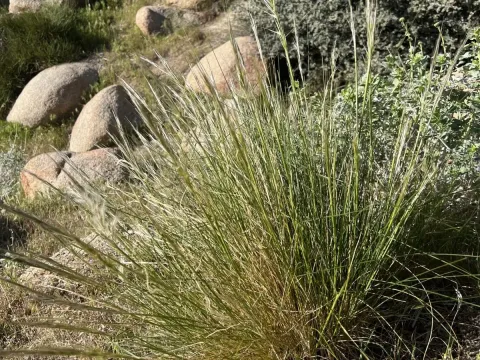
Stipa speciosa
Stipa speciosa
Stipa speciosa, commonly known as desert needlegrass, is a perennial grass species belonging to the Poaceae family, recognized for its exceptional resilience in arid environments.
What the section contains
Stipa speciosa
Its natural habitat spans the semi-arid regions of South America, where it thrives in challenging climatic conditions, forming dense, compact bunches in sandy or stony soils.
The species has a high requirement for full solar exposure and does not tolerate competition from overshadowing vegetation. It shows remarkable hardiness against extreme temperature fluctuations.
Regarding soil preferences, it demands well-drained, porous substrates. Excessive moisture or waterlogged soil conditions lead to rapid root decay and mortality of the plants.
Agronomic management is minimal, as the grass is highly self-sufficient and excels at stabilizing soil surfaces in harsh, unproductive environments where other crops fail.
The primary agricultural application of Stipa speciosa involves its use as a sustainable forage species for livestock in rangeland management during periods of drought.
It is increasingly valued in landscape architecture for its aesthetic appeal, particularly its silvery-white inflorescences that add texture and movement to dry landscape designs.
Environmental restoration projects utilize this species for its superior ability to stabilize shifting dunes and prevent wind-induced soil erosion in arid agricultural zones.
Biomass production is intrinsically linked to seasonal precipitation patterns; thus, long-term yields remain stable even with minimal input of artificial fertilizers.
The crop's longevity makes it an excellent choice for permanent soil cover, reducing the need for repeated sowing and mechanical soil tillage.
Stipa speciosa generally exhibits high resistance to conventional crop pests, which is a major advantage for low-input agricultural systems.
However, the main biological threat arises from fungal pathogens when environmental conditions become unusually humid, leading to rusts or root rot issues.
In terms of insect pressure, it remains relatively untouched by major agricultural pests due to the high silica content in its leaves, which acts as a natural deterrent.
Management-related issues often involve overgrazing, which breaks the physical integrity of the root system and encourages the invasion of opportunist weed species.
- Susceptibility to fungal diseases during prolonged wet spells.
- Risk of physical damage to root systems by overgrazing.
- Infestation by root-feeding larvae during the establishment phase.