
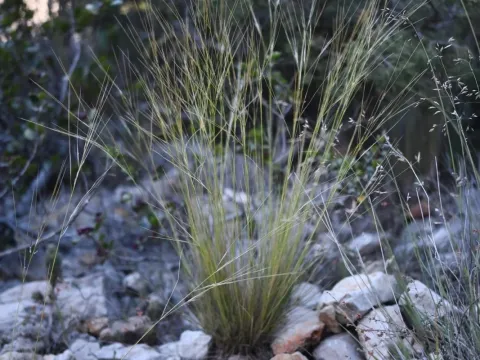
Stipa offneri
Stipa offneri
Stipa offneri belongs to the Poaceae family. It is a perennial, densely tufted grass species known for its ability to thrive in challenging environments, forming distinct, sturdy clumps that characterize its growth habit.
What the section contains
Stipa offneri
The plant originates from the arid regions of Central Asia, where it is found in stony steppes and mountain slopes. Its evolutionary development has favored high tolerance to extreme thermal fluctuations and water scarcity.
Agronomically, it requires well-drained, porous soils to flourish. It shows high sensitivity to soil compaction and waterlogging, which often result in root decay and the decline of the plant stand within a short period.
Optimal growth is achieved in full-sun exposure. The species is highly photophilous and lacks competitive mechanisms to survive under the shade of taller shrubs or canopy coverage, requiring open spaces to maintain vitality.
This grass is primarily utilized in extensive grazing systems. While mature foliage is tough and fibrous, it provides early-season forage that is crucial for livestock survival in semi-arid and highland pastures.
Fungal infections, particularly rust and powdery mildew, represent the primary health risks for Stipa offneri. These diseases typically manifest during periods of unusually high humidity, which stresses the plant's natural defenses.
Insect pests like cereal flies and stem borers are significant threats to the reproductive cycle. By damaging the stems and floral parts, these pests significantly reduce the annual seed yield of the population.
Aphids can cause substantial stress by feeding on the sap of tender spring shoots. In severe infestations, this weakens the entire root system, making the plant more susceptible to secondary infections or environmental stress.
Overgrazing poses a major threat to the long-term survival of the species. Heavy livestock pressure prevents the accumulation of enough photosynthetic biomass to survive the winter, eventually leading to local extinction.
Invasive weed encroachment represents a constant biological threat. The slow establishment phase of this grass makes it vulnerable to aggressive colonizing species that compete for limited water and soil nutrients.