
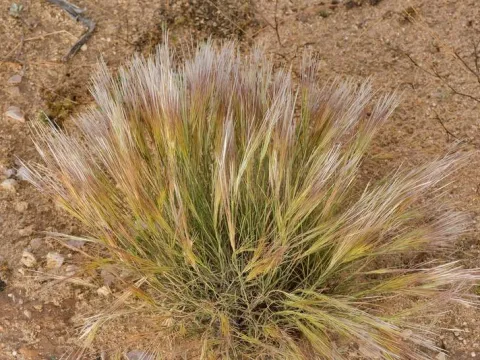
Stipagrostis
Stipagrostis
Stipagrostis is a genus of perennial grasses belonging to the Poaceae family, known for its exceptional adaptation to desert and arid environments. These plants are essential for maintaining ecological stability in regions with extremely low annual precipitation.
What the section contains
 Feather aristida
Stipagrostis pennata
Feather aristida
Stipagrostis pennata
 Feather needlegrass
Stipagrostis plumosa
Feather needlegrass
Stipagrostis plumosa
 Feather-bristle needle grass
Stipagrostis uniplumis
Feather-bristle needle grass
Stipagrostis uniplumis
 Short-leaved Stipagrostis
Stipagrostis brevifolia
Stipagrostis acutiflora
Stipagrostis acutiflora
Short-leaved Stipagrostis
Stipagrostis brevifolia
Stipagrostis acutiflora
Stipagrostis acutiflora
 Stipagrostis amabilis
Stipagrostis arachnoidea
Stipagrostis arachnoidea
Stipagrostis amabilis
Stipagrostis amabilis
Stipagrostis arachnoidea
Stipagrostis arachnoidea
 Stipagrostis ciliata
Stipagrostis ciliata
Stipagrostis ciliata
 Stipagrostis hirtigluma
Stipagrostis hirtigluma
Stipagrostis hirtigluma
 Stipagrostis karelinii
Stipagrostis karelinii
Stipagrostis karelinii
 Stipagrostis obtusa
Stipagrostis obtusa
Stipagrostis obtusa
 Stipagrostis pungens
Stipagrostis pungens
Stipagrostis pungens
 Stipagrostis raddiana
Stipagrostis scoparia
Stipagrostis scoparia
Stipagrostis vulnerans
Stipagrostis vulnerans
Stipagrostis raddiana
Stipagrostis raddiana
Stipagrostis scoparia
Stipagrostis scoparia
Stipagrostis vulnerans
Stipagrostis vulnerans
 Stipagrostis zeyheri
Stipagrostis zeyheri
Stipagrostis zeyheri
 Woolly Stipagrostis
Stipagrostis lanata
Woolly Stipagrostis
Stipagrostis lanata
Stipagrostis
The native range of Stipagrostis includes the desert landscapes of Africa, Central Asia, and the Middle East. It is highly specialized to thrive in sandy soils, where its deep root system anchors shifting dunes, effectively preventing desertification.
Botanically, the plant exhibits xerophytic characteristics, such as tightly rolled leaves that reduce water loss. These morphological traits enable the grass to maintain metabolic functions under intense heat and chronic water deficiency.
Stipagrostis requires maximum solar exposure and thrives in nutrient-poor substrates. It is strictly intolerant of waterlogging or high humidity, as these conditions disrupt its physiological balance and increase the risk of root pathogens.
In agricultural settings, this crop serves as a vital forage resource for livestock, particularly camels and goats. Beyond fodder production, it is considered a premier species for large-scale land reclamation projects in degraded desert soils.
Due to the hyper-arid environments where Stipagrostis grows, fungal and bacterial diseases are rarely a concern in natural stands. The plant's hardy structure provides a natural barrier against common cereal pathogens.
The primary biotic threats are various species of locusts and grasshoppers, which can quickly consume the plant biomass. Given the vast and often remote areas of cultivation, controlling these pests requires integrated landscape management rather than chemical intervention.
The high silica content in the foliage serves as an effective deterrent against many generalist herbivores. This chemical defense mechanism ensures the plant's survival throughout the peak growing season.
Improper grazing management represents the most significant anthropogenic threat. Overgrazing depletes the plant's reserves, leading to loss of cover and subsequent soil erosion that the plant was meant to prevent.
Effective management focuses on sustainable stocking rates and allowing sufficient rest periods for the grass to recover. Maintaining the integrity of the soil crust around the roots is essential for the long-term health of the stand.