
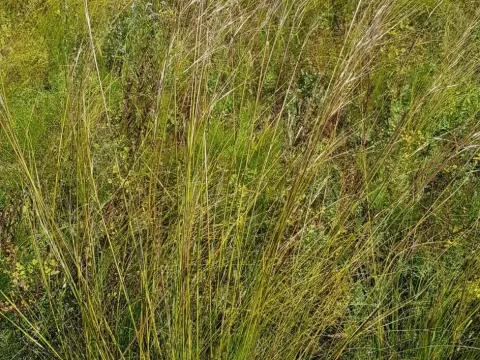
Stipa grandis
Stipa grandis
Stipa grandis is a prominent perennial grass species within the Poaceae family, widely distributed across the grasslands of East Asia. It serves as a foundational species for steppe ecosystems, contributing significantly to soil stabilization and biomass production.
What the section contains
Stipa grandis
The species is well-adapted to continental climates characterized by hot summers and cold, dry winters. It thrives in well-drained, nutrient-moderate soils, showing a remarkable ability to withstand prolonged drought conditions due to its deep-reaching root system.
Botanically, Stipa grandis grows in dense, perennial tufts. Its narrow, rigid leaves are an evolutionary adaptation designed to reduce transpiration, ensuring survival in arid environments where water availability is the limiting factor for plant growth.
Regarding agrotechnical requirements, Stipa grandis is generally managed as a low-input forage crop. Its establishment requires minimal soil tillage, and it benefits from rotational grazing patterns that allow the plants to recover during the flowering and seeding phases.
In terms of agricultural use, this species is highly valued for seasonal grazing. It provides high-quality nutrients in the early vegetative stage, though its forage value decreases significantly once the plant matures and the seed heads develop.
Like many steppe grasses, Stipa grandis faces threats from overgrazing, which can reduce its competitive advantage against opportunistic weed species and lead to significant soil degradation in fragile arid landscapes.
Insect pests, particularly locusts and other Orthoptera species, can cause substantial damage to the green canopy during outbreak years, negatively impacting the overall biomass available for livestock consumption.
Fungal pathogens such as rusts and smuts can occur under conditions of high humidity, particularly when there is poor air circulation within the grass canopy, although these are rarely devastating in wild populations.
The loss of natural fire cycles in some regions can lead to an accumulation of old, dead biomass, which may stifle the growth of new shoots and increase the vulnerability of the grass stand to secondary pathogens.
Effective management against these threats relies on monitoring grazing density and implementing burning or mowing programs to remove senescent biomass and stimulate vigorous vegetative growth.