
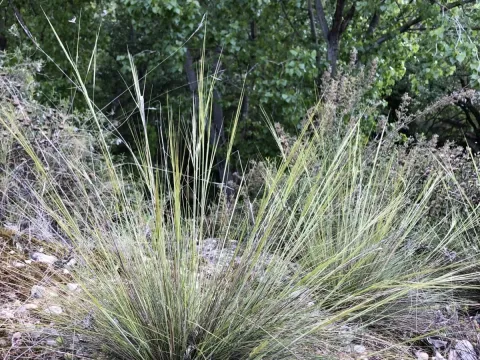
Stipa juncea
Stipa juncea
Stipa juncea is typically a perennial grass that thrives in natural ecosystems, though it is occasionally used in restoration projects. Sowing is best performed in late autumn, allowing the seeds to undergo natural stratification during the winter months.
What the section contains
Stipa juncea
The seeds should be sown at a shallow depth of 1-2 centimeters. Due to their lightweight nature, they are easily displaced by wind or heavy rain, so covering them with a thin layer of soil and compacting the surface is essential for success.
Development is very slow during the first two years, as the plant prioritizes building a strong root system. Weeding in the early stages of establishment is critical, as Stipa juncea is a poor competitor against aggressive weeds during its juvenile phase.
In the wild, the seeds utilize hygroscopic awns to burrow into the soil. When designing artificial plots, mimicking this natural process by providing a stable, open soil surface is highly beneficial for seedling survival.
Optimal planting density should balance the need for cover with the requirement for individual plant growth. Avoiding overcrowding is essential, as each plant requires sufficient access to light and soil moisture to reach maturity.
As a true xerophyte, Stipa juncea is highly adapted to arid conditions. It possesses remarkable drought tolerance, allowing it to survive in environments where traditional forage grasses would fail due to water stress.
The plant prefers well-drained soils, such as sandy loams or limestone-rich substrates. It is highly sensitive to waterlogged conditions, which lead to root rot and significant thinning of the stand, making site selection crucial.
Temperature tolerance is one of the species' greatest assets, as it handles both extreme summer heat and severe winter frost with equal ease. It starts growing early in the spring, making use of available moisture before the summer heat arrives.
Stipa juncea does not require high levels of soil fertility. It thrives in low-nutrient, marginal soils, which makes it an excellent candidate for the stabilization of eroded slopes and the restoration of degraded steppe lands.
Full sun is a non-negotiable requirement for this species. Even partial shade negatively impacts its health, reducing both vegetative vigor and the production of flowering stems, eventually leading to the decline of the plant.
In an agricultural context, Stipa juncea serves as a valuable forage plant, especially during early spring when its green leaves provide a nutritious feed source. It is particularly well-suited for grazing by sheep and hardy breeds of cattle.
While the total biomass yield is lower than that of intensive monoculture grasses, Stipa juncea offers greater reliability in drought-prone areas. Its ability to provide green feed during the hottest months is a distinct advantage.
Hay production requires timing to be perfect. Harvesting must occur before the plant enters its late flowering stage to avoid the development of stiff, sharp awns that can cause physical injury to the mouths of grazing animals.
Seed yield is moderate and can be difficult to manage due to the plant's tendency for uneven ripening. However, when managed properly, it can provide a sufficient source of native seeds for future grassland improvement projects.
The ecological yield, including soil carbon sequestration and biodiversity support, is perhaps the most significant benefit of this species. It acts as an anchor for the soil and a refuge for various pollinators and steppe insects.
Fungal diseases are the primary threat, particularly during cool, damp springs. Rust and powdery mildew can weaken the stands, especially if the air circulation around the plants is obstructed by thick accumulation of dead biomass.
Various insects, including grass-feeding flies and aphids, can cause significant damage during the active growing season. These pests typically attack the leaves or the developing inflorescences, reducing both vegetative health and seed viability.
Overgrazing is the most detrimental human-induced threat. Continuous, intensive grazing prevents the plant from replenishing its carbohydrate reserves in the roots, leading to a gradual loss of the population and invasion by undesirable weeds.
Uncontrolled wildfires represent a major risk, especially in years with high litter buildup. Although the plant is somewhat adapted to fire, frequent exposure can exhaust the plant's resources and reduce its survival rate.
Competition from invasive plant species is a persistent problem. Because Stipa juncea is slow-growing initially, it can easily be outcompeted by fast-growing annual weeds if the site is not carefully monitored and maintained.
Harvesting for forage is best done using traditional mowing equipment during the early vegetative stage. The aim is to capture the plant before it becomes too fibrous, ensuring the highest possible quality for the livestock.
For seed collection, direct combining is possible, but it requires careful calibration of the threshing drum to prevent damage to the delicate structures of the awns. Harvesting in the early morning can help reduce shattering losses.
Post-harvest processing involves thorough drying in a shaded area to maintain seed quality. Proper moisture control is essential, as the seeds should not be stored while damp to avoid mold development or overheating.
Cleaning the seeds is necessary to remove chaff and debris, which simplifies the sowing process and ensures more uniform distribution in the field. This also helps in calculating precise seeding rates for future projects.
Safety is a priority when handling matured Stipa juncea. The sharp awns can be a nuisance to handlers and a hazard to livestock, so timely harvest remains the best management strategy to mitigate these risks effectively.