
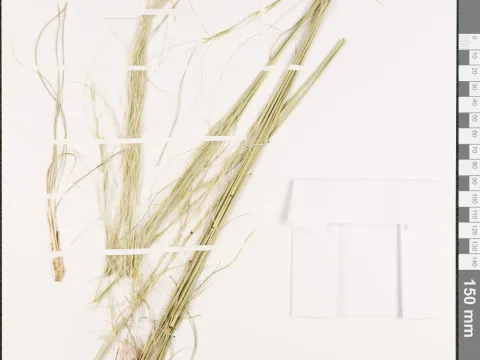
Arabian needlegrass
Stipa arabica
Arabian needlegrass (Stipa arabica) is a perennial grass species belonging to the Poaceae family. It is recognized primarily for its exceptional resilience in challenging environments, making it a valuable resource for arid and semi-arid grazing systems.
What the section contains
Arabian needlegrass
The plant originates from desert and steppe regions of the Middle East and Central Asia. It has evolved to thrive in environments characterized by high solar radiation, extreme temperature fluctuations, and irregular, low precipitation levels.
Regarding soil requirements, Stipa arabica is highly undemanding. It successfully colonizes stony, sandy, and alkaline soils where conventional forage crops would fail to survive. Its root system is exceptionally deep, facilitating nutrient and water uptake from deeper soil horizons.
Botanically, the species forms dense clumps or tussocks, which provide excellent soil stabilization against wind erosion. Its narrow, rolled leaves are a structural adaptation to minimize water loss through transpiration during periods of intense heat.
The primary agricultural application for this grass is as a forage source in rangelands. It is particularly valued for its ability to maintain a baseline nutritional profile even when dormant, supporting livestock during dry seasons.
Pathogenic fungi, such as rusts, represent the most common botanical threat to Arabian needlegrass, especially if localized humidity levels rise unexpectedly during the growing season.
Insect pests, particularly locusts and grasshoppers, can cause significant damage to the plant's foliage. Large-scale infestations often require integrated pest management strategies to protect rangeland productivity.
Overgrazing remains the most critical management-related threat. If the grazing intensity exceeds the natural regeneration rate of the grass, the root system weakens, leading to land degradation and the encroachment of invasive weed species.
Soil-borne pathogens may also affect the plant if the ecological balance of the rangeland is disrupted, leading to stunted growth or increased vulnerability to environmental stress.
Ensuring sustainable grazing rotations is the most effective approach to mitigate these threats, allowing the plants to recover and maintain their vigor over multiple seasons.