
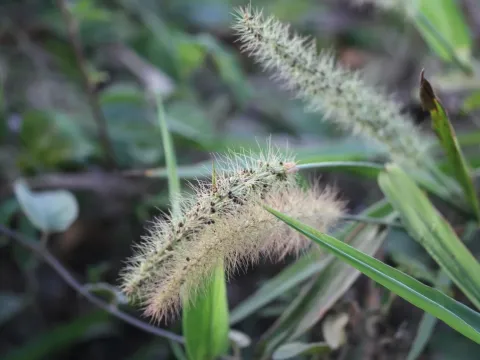
Bristly foxtail
Setaria tenax
Bristly foxtail is an annual grass species that begins to germinate when soil temperatures reach 10-12 degrees Celsius. The ideal window for emergence is in late spring as the weather stabilizes and the risk of frost dissipates.
What the section contains
Bristly foxtail
The plant exhibits high germination vigor, allowing it to quickly colonize available soil space. Massive emergence is typically observed in May and June, which presents a challenge for late-planted crops.
The life cycle is relatively short, which enables the plant to produce seeds even if emergence occurs later in the season. This makes it a highly persistent competitor in row crop fields.
Agronomically, it is crucial to perform mechanical cultivation before the mass emergence of the crop. Systemic herbicides are most effective when applied during the active growth phase, prior to the flowering stage.
Seeds of bristly foxtail can remain viable in the soil for several years. This longevity necessitates a well-planned crop rotation strategy to deplete the seed bank within the agricultural fields.
Bristly foxtail belongs to the Poaceae family and prefers moist, nutrient-rich soils. It thrives particularly well on loamy or sandy loam soils that possess a neutral pH level.
The plant is highly shade-intolerant and struggles to develop in dense crop canopies. Reduced sunlight availability significantly suppresses its growth and reproductive output compared to open areas.
Optimal growth conditions involve temperatures ranging between 20 and 25 degrees Celsius. Ample moisture availability allows the plant to develop a deep and robust root system capable of extracting significant nutrients.
The species is highly plastic and can adapt to various environmental stressors. It is frequently found along roadsides, in neglected fields, and near irrigation systems where water is consistently present.
While historically considered by some as a potential forage grass, its primary significance in modern agriculture is that of an aggressive weed that competes with cereal and vegetable crops.
Major diseases affecting bristly foxtail include fungal infections such as smut and various rusts. These pathogens can occasionally migrate to agricultural cereal crops, potentially impacting the overall farm yield.
The plant acts as a host reservoir for various pests, including aphids and grain beetles. In cases of large pest outbreaks, the presence of these weeds can support and sustain pest populations near crop fields.
Chemical control can be difficult due to the weed's resilience to certain herbicides. Effective management usually requires an integrated approach, combining proper cultivation with timely herbicide applications.
Biological control research focuses on specific pathogens that target the genus Setaria. While promising in experimental settings, these methods are not yet standard practice in large-scale commercial farming.
Mechanical removal, including hoeing and inter-row cultivation, remains the most effective strategy when performed before the onset of flowering. Delaying removal until after seed set significantly increases the risk of further field infestation.