
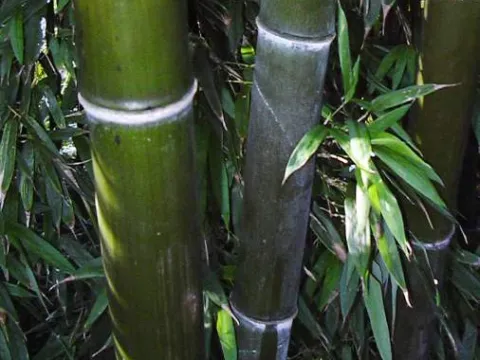
Phyllostachys
Phyllostachys
The propagation of Phyllostachys in both commercial and amateur scales is primarily carried out through vegetative methods. The optimal time for dividing rhizomes is early spring, the period before the onset of active sap flow and the growth of new shoots.
What the section contains
 Bisset's bamboo
Phyllostachys bissetii
Bisset's bamboo
Phyllostachys bissetii
 Golden bamboo
Phyllostachys aurea
Golden bamboo
Phyllostachys aurea
 Incense Bamboo
Phyllostachys atrovaginata
Incense Bamboo
Phyllostachys atrovaginata
 Meyer bamboo
Phyllostachys meyeri
Meyer bamboo
Phyllostachys meyeri
 Phyllostachys
 hybrids
Phyllostachys
Phyllostachys hybrids
 Phyllostachys flexuosa
Phyllostachys flexuosa
Phyllostachys flexuosa
 Phyllostachys humilis
Phyllostachys humilis
Phyllostachys humilis
 Phyllostachys makinoi
Phyllostachys makinoi
Phyllostachys makinoi
 Phyllostachys mannii
Phyllostachys mannii
Phyllostachys mannii
 Phyllostachys nidularia
Phyllostachys nidularia
Phyllostachys nidularia
 Phyllostachys reticulata
Phyllostachys reticulata
Phyllostachys reticulata
 Phyllostachys viridiglaucescens
Phyllostachys viridiglaucescens
Phyllostachys viridiglaucescens
 Phyllostachys viridis
Phyllostachys viridis
Phyllostachys viridis
 Phyllostachys vivax
Phyllostachys vivax
Phyllostachys vivax
 Sulfur bamboo
Phyllostachys sulphurea
Sulfur bamboo
Phyllostachys sulphurea
 Sweet shoot bamboo
Phyllostachys dulcis
Sweet shoot bamboo
Phyllostachys dulcis
 Tortoise shell bamboo
Phyllostachys heterocycla
Tortoise shell bamboo
Phyllostachys heterocycla
 Yellow groove bamboo
Phyllostachys aureosulcata
Yellow groove bamboo
Phyllostachys aureosulcata
Phyllostachys
Seed propagation of this crop is used extremely rarely, as bamboo flowering is an infrequent and irregular phenomenon, often accompanied by the death of the parent plant after the fruiting cycle is completed.
For planting, select areas with loose, well-drained soil, pre-enriched with organic fertilizers, which facilitates rapid rooting of the divisions.
When planting, it is important to maintain distance between plants, as Phyllostachys possesses an aggressive root system (leptomorph type) capable of rapidly conquering the territory.
The first year after planting requires regular watering so that the root system can adapt to new growth conditions before the onset of adverse climatic factors.
Phyllostachys belongs to the Poaceae family and is a woody bamboo with powerful, hollow stems. The culture originates from regions of East Asia, from where it has spread across the subtropical belts of the planet.
The crop has high requirements for air and soil humidity. For full development, Phyllostachys needs well-lit areas protected from cold northern winds, which can damage young growth.
The plant prefers loamy or sandy loam soils with a neutral or slightly acidic pH. Stagnant water in the root zone is fatal to the crop, therefore, high-quality drainage is mandatory when establishing plantations.
Temperature regime is a limiting factor: most Phyllostachys species withstand brief frosts, but prolonged periods of sub-zero temperatures require covering or mulching the root zone.
During the active vegetation period, the crop is in acute need of nitrogen fertilizers, which stimulate the rapid growth of biomass characteristic of representatives of the Bambusoideae subfamily.
The productivity of Phyllostachys is measured by the volume of stem biomass formed annually. With proper care, a plantation is capable of producing a high yield of wood, which in strength is comparable to softwood timber.
Commercial use includes applying stems in the production of furniture, construction materials, flooring, and decorative elements. Phyllostachys is also actively used in landscaping as a fast-growing living barrier.
Young shoots of some Phyllostachys species are edible and are highly valued in Asian cuisine as a delicacy rich in fiber and minerals.
Yield depends on the age of the plantation: full industrial potential is reached by the 5th–7th year of life, when the root system has fully occupied the assigned plot.
An important aspect is thinning the plantings: removing old and damaged stems contributes to an increase in the diameter and quality of new shoots in subsequent seasons.
The main pests of Phyllostachys are sap-sucking insects, such as aphids and spider mites, which actively develop in conditions of low air humidity.
When soil is waterlogged, plants can be affected by fungal infections that cause rhizome rot and stem spotting, sharply reducing the decorative and commercial quality of the wood.
To prevent the spread of diseases, it is necessary to ensure good air circulation within the thickets, avoiding overcrowding, and to remove dead plant parts in a timely manner.
Chemical protection includes the use of systemic insecticides and fungicides; however, when growing edible shoots, preference should be given to biological methods of pest control.
Weeds do not pose a significant threat to mature Phyllostachys plantations, as bamboo creates a dense canopy that suppresses the development of competing vegetation.
Harvesting Phyllostachys stems is carried out in the autumn-winter period, when the sap content in the wood is minimal, which guarantees high density and durability of the finished material.
The harvesting technology involves cutting stems at a certain height from the ground, while it is important not to damage the main rhizomes that ensure the regeneration of the plant in the next season.
The collection of shoots intended for human consumption is carried out exclusively in the spring, when they are just appearing above the soil surface and reaching a height of 10–20 centimeters.
After harvesting, the stems undergo primary processing: cleaning from leaves, calibration by diameter, and drying, which can take from several weeks to months depending on the conditions.
Adherence to storage rules for harvested raw materials — protection from direct sunlight and high humidity — is critically important for preserving the physical and mechanical properties of the bamboo.