
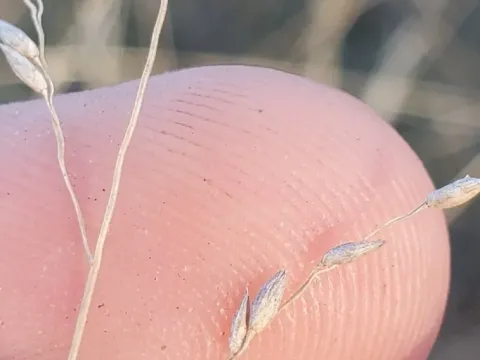
Hall's panicgrass
Panicum hallii
Hall's panicgrass (Panicum hallii) is a perennial grass belonging to the Poaceae family. It is recognized for its remarkable genetic diversity and its ability to thrive in harsh environments that are typically unsuitable for most commercial cereal crops.
What the section contains
Hall's panicgrass
The species is native to the southwestern United States and northern Mexico. It has evolved in arid and semi-arid climates, developing specialized physiological traits to withstand extreme heat and prolonged water deficit conditions.
Regarding soil requirements, Panicum hallii is highly adaptable, showing success in rocky, sandy, and alkaline soils. Its root architecture allows for effective water uptake, making it a subject of interest for sustainable agriculture in arid zones.
Botanically, the plant grows in clumps with narrow leaves covered in a thin cuticle to prevent excessive water loss. Its reproductive cycle is well-synchronized with seasonal rainfall patterns, ensuring survival during dry spells.
In modern agricultural science, Hall's panicgrass serves as a vital model organism. Researchers use its genome to understand the genetic basis of drought tolerance, aiming to improve the resilience of other major food crops through biotechnology.
Hall's panicgrass possesses a robust innate defense system against many pathogens due to its evolutionary adaptation to wild environments, where it competes with other vegetation.
The most common disease threats include fungal infections such as leaf rusts, which can proliferate if the plant is grown in irrigation-heavy or high-humidity greenhouse environments.
Pest pressures are generally low in its native habitat; however, generalist herbivorous insects such as grasshoppers and aphids can occasionally damage foliage and inflorescences during outbreaks.
Root-feeding insects can also pose a minor threat to younger plants, particularly in experimental fields where soil biodiversity may be altered compared to natural grasslands.
Integrated pest management strategies for this plant remain focused on natural biological controls rather than synthetic pesticides, preserving its status as an environmentally sustainable research species.