
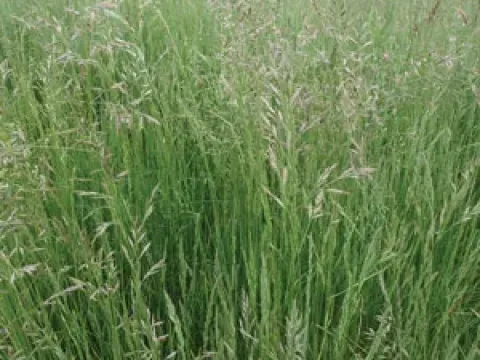
Hard fescue
Festuca brevipila
Hard fescue (Festuca brevipila) belongs to the Poaceae family and is recognized as a hardy, low-maintenance perennial grass. Sowing is best performed in early spring or late summer to ensure successful germination and seedling establishment before the onset of extreme weather conditions.
What the section contains
Hard fescue
The seeds should be sown at a depth of 1-2 centimeters. Because the seeds are quite small, maintaining adequate soil moisture in the seedbed is crucial during the initial stages of development to support uniform emergence.
When used for turf or pasture, seeding rates are calibrated based on specific project goals and the desired density of the sward. Hard fescue is often integrated into seed mixtures, where it complements other grasses by providing a durable and dense growth habit.
The initial growth phase of this grass is relatively slow, making weed management essential during the first months. Once the plant matures and begins to tiller, it forms a dense mat that naturally suppresses the growth of competitive weeds.
The plant demonstrates high persistence and can maintain its productivity for many years. When rotating crops, the established sod is easily tilled, effectively adding organic matter back into the soil and improving its structural integrity for subsequent plantings.
Hard fescue is known for its remarkable environmental adaptability, thriving in various well-drained soil types, particularly sandy and loamy soils. It is notably drought-tolerant, which makes it an excellent choice for regions with limited precipitation.
The species prefers full sunlight but exhibits a notable tolerance for partial shade, which increases its utility in various landscaping and conservation scenarios. It performs well across a broad range of soil pH levels.
Strategic fertilization is recommended to maintain peak performance. Nitrogen applications in early spring promote vigorous green-up, while fall applications of phosphorus and potassium support root development and enhance winter hardiness.
Effective drainage is vital, as hard fescue does not tolerate waterlogged conditions, which can lead to root rot and thinning of the stand. Careful site preparation, including grading and subsoil improvement, helps ensure the long-term viability of the crop.
The grass is highly resilient to cold temperatures, surviving harsh winters without significant damage. Its ability to perform well in poor soil conditions makes it a reliable solution for revegetation projects on degraded lands and steep slopes.
The primary agricultural applications of hard fescue include sustainable forage production, premium turf management, and soil erosion control. The harvested biomass yield is largely dependent on the frequency of cutting and the overall nutritional management of the field.
It is well-suited for pasture use due to its ability to recover quickly following grazing. While it may not reach the yields of some highly intensive forage species, its nutritional profile, particularly in terms of fiber and protein content, is adequate for livestock feed.
Seed production requires careful timing, with harvesting conducted during the phase of full seed maturity to prevent shattering and harvest losses. Utilizing specialized combine equipment ensures high purity and germination rates for the seed harvest.
Its role in phytoremediation is significant, as the extensive root system stabilizes the soil profile, making it a preferred choice for slope protection and land reclamation. These environmental benefits are often prioritized alongside forage yields in management plans.
The economic sustainability of the crop is bolstered by its long-term persistence, which reduces the need for frequent reseeding. Consistent management and proper harvesting techniques ensure stable yields throughout the lifespan of the perennial stand.
Common diseases affecting hard fescue include rusts and various leaf spot pathogens, which typically appear during periods of high humidity and poor airflow. Managing plant density and timing of harvests are effective preventative measures.
Powdery mildew can also occur, particularly when there are wide fluctuations in temperature. Promoting good canopy aeration and avoiding excessive fertilization helps mitigate the spread of fungal infections throughout the field.
Pests such as wireworms and various white grub species represent a threat to the root system, potentially causing patchy growth or stand thinning. Integrated pest management strategies are advised if population thresholds are exceeded.
Aphids and certain cereal flies can cause damage during the active growing season by feeding on plant sap. Encouraging the presence of natural beneficial insect populations is a sustainable strategy to keep pest pressure within manageable levels.
Overall, hard fescue is considered a robust plant species with a high level of resistance to most common diseases, provided standard agronomic practices are followed. A well-maintained crop effectively minimizes the risk of widespread infection.