
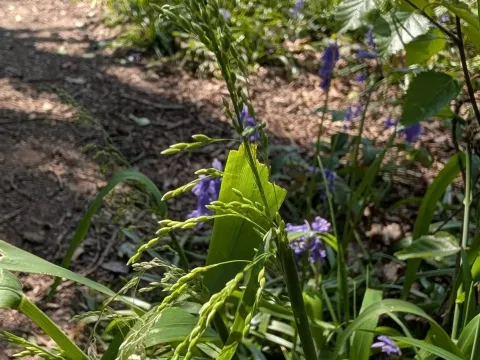
Wood millet
Milium effusum
Sowing Wood millet seeds is primarily carried out in the autumn, allowing for natural stratification to ensure better spring germination. In regions with milder climates, early spring sowing is possible once the soil has warmed sufficiently.
What the section contains
Wood millet
For establishing a dense sward, a seeding rate of approximately 8–10 kg per hectare is recommended for broadcast sowing. Seeds should be buried shallowly, no more than 1–1.5 cm deep, as they require close contact with moist soil to germinate successfully.
When used as an ornamental plant, sowing is typically done in prepared nursery containers or trays before transplanting to a permanent location. This practice allows for controlled plant density and ensures each specimen has adequate space for development.
Maintaining consistent moisture in the topsoil layer during the first few weeks after emergence is crucial. Drying out of the seedbed during this phase can be fatal to young seedlings, which possess relatively fragile root systems.
In natural habitats, the species spreads mainly via seeds, forming dense clumps. In cultivation, managing sowing density helps prevent thinning or overcrowding, both of which can negatively affect overall shoot development and plant vigor.
Wood millet (Milium effusum) belongs to the Poaceae family and is a characteristic shade-tolerant grass. Unlike most agricultural crops, it performs best in partial shade or under tree canopies, making it a valuable component in agroforestry systems.
The plant prefers moderately moist, humus-rich, and well-aerated soils. It struggles with both prolonged waterlogging and extreme substrate drought, thus making woodland loams the ideal environment for its cultivation.
The crop exhibits high winter hardiness and can adapt to temperature fluctuations in temperate climates. The optimal temperature range for active vegetative growth is between +15 and +22 degrees Celsius.
Agronomic management requires the application of organic fertilizers during the initial planting stage. On nutrient-poor soils, moderate spring nitrogen top-dressing is recommended to stimulate the development of green biomass.
When selecting a planting site, it is important to avoid areas exposed to direct, scorching midday sun, as this often leads to leaf scorching and a significant reduction in overall crop productivity and vigor.
The economic use of Wood millet is primarily concentrated in the breeding of ornamental cultivars and as part of forest forage systems. Green biomass yields depend directly on soil fertility and the level of light exposure at the site.
When included in pasture mixtures, the plant is valued for its high nutritional content and ability to regrow after grazing or mowing. Its cold tolerance allows it to provide early green fodder during the spring season.
Botanically, the plant is a loose-tufted perennial grass reaching heights of 60 to 120 cm, featuring characteristic spreading panicles. The foliage is soft and bright green, making it highly palatable for livestock.
Ornamental use includes cultivating varieties with golden foliage, which are in high demand among landscape designers. The yield of decorative dried panicles is also considered when growing the plant for floral and artistic applications.
Breeding efforts focus on enhancing clump density and lodging resistance, which enables higher biomass output per unit area under intensive management practices.
The primary threats to Wood millet include fungal diseases that thrive in conditions of stagnant air and excessive humidity. Powdery mildew, in particular, can significantly reduce both the ornamental and forage quality of the stand.
Regarding pests, cereal flies and aphids pose the greatest risk by damaging young leaves during periods of rapid growth. Preventive spraying with bio-insecticides during the tillering stage is effective in controlling these infestations.
Root rots may occur if soil drainage is inadequate. Proper crop rotation and avoiding overwatering are the most effective preventive measures against the spread of soil-borne pathogens within the stand.
Weed competition during the early establishment phase is significant. Timely weeding is essential until the plant forms a mature, robust clump capable of suppressing opportunistic weeds through its dense growth habit.
- Maintain appropriate irrigation to prevent root rot
- Use systemic fungicides if fungal outbreaks occur
- Regular monitoring of leaf surfaces for pest damage
- Remove plant debris to minimize the infectious background
Harvesting green mass for forage should be conducted during the boot stage or at the beginning of heading. During this window, the nutrient content in the foliage is at its peak, ensuring optimal digestibility and feed quality.
For ornamental purposes, panicles should be harvested in the full bloom phase, when they are most expressive and structurally sound. Drying should be done in the shade to preserve the natural color of the leaves and panicles.
Mowing should not be performed too low to protect the growing point and ensure rapid regrowth. An optimal cutting height is 5–7 cm above the soil surface.
When harvesting seeds, collection should begin as soon as the lower spikelets of the panicle turn brownish. It is crucial to harvest before mass shedding occurs, given that seeds on a single panicle do not mature simultaneously.
Post-harvest seed processing includes cleaning impurities and drying in a well-ventilated area until moisture content reaches no more than 12–14 percent to ensure longevity in storage.