
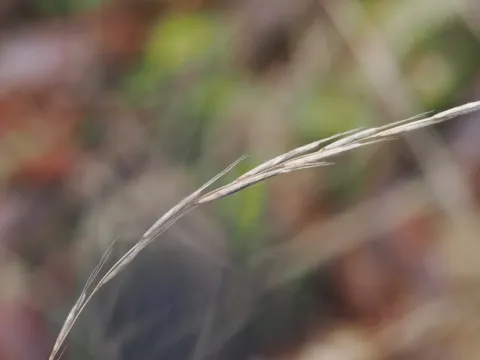
Wood false-brome
Brachypodium sylvaticum
Wood false-brome (Brachypodium sylvaticum) is a perennial herbaceous plant belonging to the Poaceae family. It is a valuable forest-meadow crop, characterized by high shade tolerance and the ability to develop successfully in temperate climates.
What the section contains
Wood false-brome
This species prefers fresh, sufficiently fertile forest and loamy soils with a neutral or slightly acidic pH. While the plant does not tolerate waterlogging well, it requires stable moisture throughout the growing season to form a dense sward.
In its natural habitat, the crop is common in the forest zones of Europe, Asia, and North Africa. In an agricultural context, it is valued as a component of seed mixtures for shaded pastures and areas with limited sunlight exposure.
Botanically, the crop is a loose-tufted grass reaching heights between 40 and 100 cm. The leaf blades have characteristic pubescence, and the inflorescence consists of a drooping raceme, which distinguishes it from other meadow grasses.
The biological characteristics of the plant allow it to compete effectively with other species in forest ecosystems. The root system of false-brome is well-developed, contributing to soil stabilization on slopes and preventing erosion.
The optimal time for sowing wood false-brome is early spring, as soon as the soil warms up to 5-8 degrees Celsius. Early sowing allows plants to maximize the use of moisture accumulated after snowmelt.
Winter sowing in late October, before the onset of persistent frosts, is also permitted. This ensures seed stratification, which promotes more uniform germination in the spring.
The seeding rate depends on soil type and intended use, typically ranging from 10-15 kg per hectare for pure stands. The sowing depth should not exceed 1-2 cm due to the small size of the seeds.
To improve establishment, pre-sowing rolling is recommended to ensure better contact between seeds and moist soil. When establishing perennial pastures, false-brome is often sown in mixtures with other shade-tolerant grasses.
During the first months after sowing, the crop develops slowly, so timely weed control is essential. Once established, the sward becomes sufficiently dense and resistant to invasive weeds.
The green mass yield of wood false-brome is moderate compared to intensive agricultural grasses. Under optimal conditions, it can reach up to 15-20 tons of green mass per hectare in a single full harvest.
The primary value of the crop lies not in record volume figures, but in high nutritional quality and palatability for livestock. The plant maintains its quality well until the beginning of the heading phase.
To maximize production, it is important to adhere to cutting schedules, preventing the stems from becoming too coarse. Use as a pasture crop requires rotational grazing to avoid excessive trampling.
The nutritional value of the crop remains stable over a long period, making it an important component for forming long-term cultivated hayfields. Tolerance to temperature fluctuations ensures consistent yields over the years.
An additional factor in economic efficiency is the high seed productivity of wild populations, which allows for the use of local seed material when establishing agroecosystems.
Wood false-brome has a relatively high natural immunity; however, in monoculture, it can be affected by fungal diseases typical of grasses. Among these, leaf rust and various types of powdery mildew are most common.
To prevent the spread of infections, it is necessary to avoid dense stands and ensure good air circulation in the sward. If initial symptoms of disease appear, early mowing is recommended to reduce the infection pressure.
Pests, such as cereal flies and aphids, can cause localized damage during the early stages of growth. Timely application of phosphorus-potassium fertilizers strengthens plant cell walls, increasing their resistance to insects.
Nematodes may attack the root system when grown on waterlogged areas, requiring water balance control. Crop rotation remains an important preventive method.
Overall, the high ecological plasticity of the species allows for minimized chemical treatments, which is important for organic farming. Primary protection is based on agrotechnical practices and maintaining general soil health.
Hay harvesting is recommended at the beginning of the flowering phase. This provides an optimal balance between the quantity of biomass and the content of nutrients, such as proteins and sugars.
When used as pasture forage, the grazing height should be set at 5-7 cm. This stimulates regrowth and protects the growing point at the base of the plant.
In forest-steppe conditions, two full harvests are usually possible with sufficient moisture. After the second harvest, plants need time to accumulate nutrients in the rhizomes before wintering.
For seed harvesting, crops are cut when the spikelets acquire a straw-like color but before mass shattering. Standard grain harvesters are used with appropriate screen and wind adjustments.
The harvested seed crop requires immediate cleaning and drying to 12-14% moisture. Storage should be in cool, dry rooms, ensuring high germination rates for 2-3 years.