
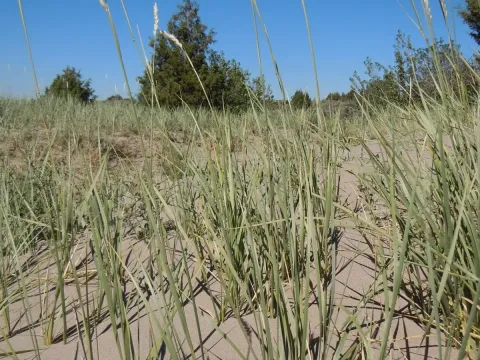
Yellow wildrye
Elymus flavescens
Yellow wildrye (Elymus flavescens) is a perennial grass species belonging to the Poaceae family. Native to the sand dunes of the interior Pacific Northwest in North America, it is highly specialized for life in harsh, low-nutrient environments.
What the section contains
Yellow wildrye
The plant is defined by its deep, extensive rhizomatous root system. This morphological feature allows it to stabilize loose sand, making it a critical species for ecological restoration projects aimed at preventing dune movement and wind erosion.
Regarding soil requirements, the plant thrives in coarse-textured, sandy soils that have excellent drainage. It is poorly adapted to heavy clay or waterlogged soils, which restrict the growth of its subterranean organs.
Climatic adaptability is one of its primary strengths. It is well-suited to regions with cold winters and hot, dry summers, as it enters a state of physiological rest when moisture is limiting, conserving energy for the next growing season.
Agronomically, it is not used as a forage crop in intensive agriculture but rather as a primary component in conservation seed mixes. It is frequently utilized by land management agencies to restore damaged landscapes where other species fail to establish.
Yellow wildrye is generally resilient to pests. However, it can be susceptible to various species of rust fungi (Puccinia spp.) that appear during prolonged damp periods in the spring, potentially reducing seed viability.
Insect pests include aphids and grasshoppers. While localized infestations can occur, the plant's robust nature allows it to recover quickly under favorable conditions without the need for intensive chemical intervention.