
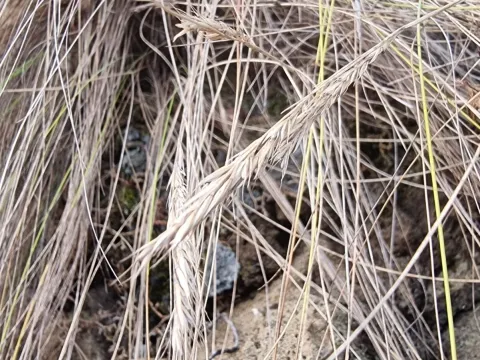
Festuca jubata
Festuca jubata
Festuca jubata is a cool-season grass species that thrives when sown in early spring or late autumn, taking advantage of moderate moisture levels.
What the section contains
Festuca jubata
For optimal results, seeds should be sown at a shallow depth of approximately 1 to 2 centimeters to ensure enough light exposure for germination.
The soil should be prepared by loosening the top layer, and after sowing, it is beneficial to press the soil surface to improve seed-to-soil contact.
Sowing in autumn allows seeds to undergo natural cold stratification, which significantly improves emergence uniformity in the following spring season.
The culture establishes quickly and exhibits strong initial growth, making it highly competitive against common weeds if sown at the correct density.
As a member of the Poaceae family, Festuca jubata demonstrates remarkable adaptability to various soil types, ranging from sandy to slightly heavy loam soils.
The plant performs best in full sunlight, which is crucial for maintaining its characteristic color and compact growth habit throughout the growing season.
It is highly drought-tolerant once established and performs poorly in waterlogged conditions, requiring well-drained soil for long-term survival.
The plant is well-suited to moderate temperature regimes and shows excellent winter hardiness, allowing it to persist across various climate zones.
Minimal fertilization is required, as the species is adapted to low-nutrient environments, though occasional potassium application can boost vigor.
The primary concern for Festuca jubata is the risk of fungal diseases, particularly when planted in areas with poor drainage and excessive air humidity.
Powdery mildew can occur if the plants are overcrowded, which restricts airflow and creates an environment favorable for pathogen development.
Occasional infestations of aphids may occur during periods of rapid leaf growth, potentially causing cosmetic damage to the delicate foliage.
Root rot can be a significant threat if the plants are kept in constantly wet conditions, leading to plant death and reduced stand density.
Effective management involves ensuring proper spacing, avoiding overwatering, and maintaining general hygiene in the growing area to prevent infection.