
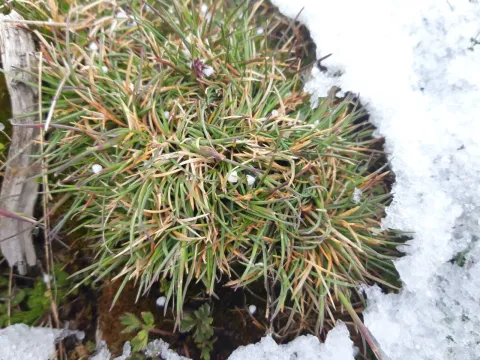
Festuca indigesta
Festuca indigesta
Festuca indigesta, commonly known as a type of hard-leaved fescue, belongs to the Poaceae family. This perennial grass is native to the mountainous regions of the Iberian Peninsula, where it thrives in harsh, rocky environments at high altitudes.
What the section contains
Festuca indigesta
The plant is highly valued for its ability to grow in poor, dry, and well-drained soils. Its deep root system is specialized for anchoring in stony substrates, making it an excellent candidate for erosion control and xeriscaping in arid climates.
Regarding cultivation requirements, this grass demands full sun exposure to maintain its compact, tufted growth habit and distinct bluish-green color. It is highly intolerant of wet, waterlogged soils and high-nutrient fertilizers, which can cause the plant to lose its typical form.
The botanical structure consists of dense, rigid tussocks with filiform leaves. These morphological features are adaptations to survive intense solar radiation and low moisture levels. The plant is drought-resistant and hardy against extreme temperature fluctuations.
Its primary use is ornamental, particularly in rock gardens or alpine-themed landscapes. While its nutritional value for livestock is minimal due to the toughness of its leaves, its ecological role as a soil stabilizer in degraded or rocky terrain is significant.