
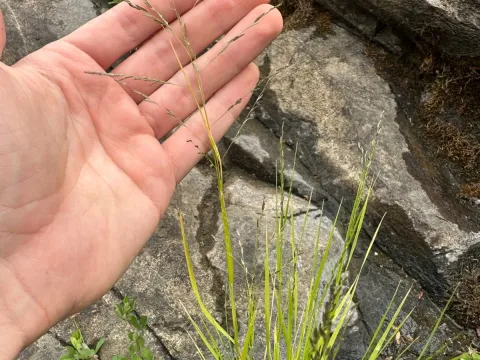
Tufted lovegrass
Eragrostis pectinacea
Tufted lovegrass (Eragrostis pectinacea) is an annual grass species belonging to the Poaceae family. It is a warm-season grass that thrives during periods of high temperature and significant solar radiation.
What the section contains
Tufted lovegrass
Germination typically occurs in late spring or early summer once soil temperatures consistently exceed 15-20°C, marking the beginning of its rapid vegetative cycle.
The plant demonstrates aggressive growth habits, which allow it to establish quickly in open spaces or within disturbed agricultural soils.
Biological resilience is a key feature, as the plant can produce multiple generations of seeds if environmental conditions remain favorable throughout the growing season.
Dispersal is primarily facilitated by wind, water, and human activity, making it a persistent colonizer of agricultural fields and roadsides alike.
This species is highly adaptable to various soil textures but shows a distinct preference for sandy, well-drained, and nutrient-poor soils where competition is lower.
Tufted lovegrass is characterized by high drought tolerance, enabling it to survive in arid environments where other species fail to thrive.
Adequate sunlight is essential for its development; the plant performs poorly in shaded environments, which restricts its spread in densely canopied crop fields.
It exhibits a flexible root structure that allows for efficient moisture uptake during short intervals of rainfall, compensating for its lack of deep-rooted persistence.
While not strictly demanding in terms of soil fertility, it responds positively to nitrogen availability when competing with other vegetation for limited resources.
Management in agricultural settings requires early mechanical intervention, such as rotary hoeing or inter-row cultivation, before the plant reaches the reproductive stage.
Chemical control can be challenging due to the inherent resistance of many Eragrostis species to common herbicides, necessitating the use of targeted grass-specific products.
Biotic stressors such as pests and diseases have limited impact on this grass, as its silica-rich leaves provide a natural defense against most herbivorous insects.
Preventative measures include thorough cleaning of harvesting machinery and monitoring field edges to prevent the encroachment of seeds into active crop zones.
Ongoing research focuses on managing its rapid expansion by maintaining healthy crop stands that shade out the seedlings before they can establish dominance.