
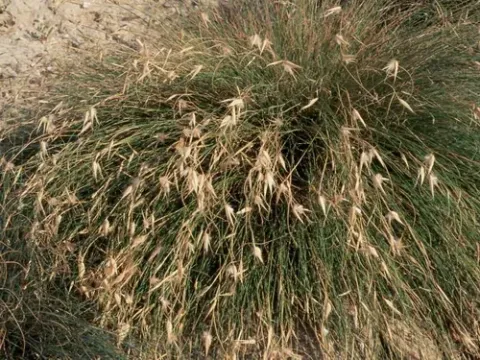
Tristachya
Tristachya
Tristachya is a genus of perennial grasses belonging to the family Poaceae. These plants are primarily native to tropical and subtropical regions, with significant distribution across Africa and parts of South America where they thrive in savanna ecosystems.
What the section contains


Tristachya
The culture has specific climatic requirements, favoring warm temperatures and distinct seasonal rainfall patterns. It demonstrates a notable level of drought tolerance, which is a key adaptation for survival in regions characterized by prolonged dry spells.
Regarding soil preferences, Tristachya requires well-drained substrates ranging from sandy to loamy textures. It does not tolerate waterlogged conditions, which makes site selection for potential cultivation critical to avoid root stress and pathogen buildup.
Botanically, the genus is characterized by its distinct inflorescence structure, where the spikelets are arranged in groups of three. This structural feature is consistent across the genus and distinguishes it from many other common pasture grasses found in similar environments.
In terms of agricultural utility, the primary use of Tristachya is in extensive grazing systems. While not as high-yielding as intensive fodder crops, it plays a vital role as a drought-resistant forage source, contributing to the stability of rangelands in its natural habitat.