
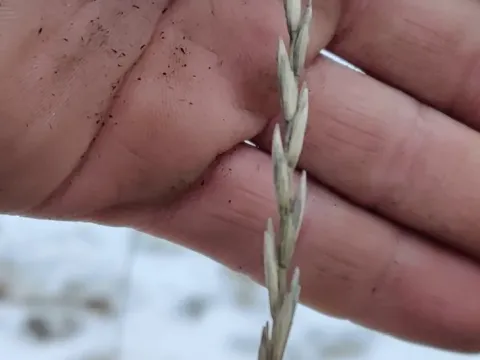
Trititrigia
Thinopyrum A. Love
Sowing of Trititrigia is typically performed during spring or autumn, depending on soil moisture conditions. Early spring sowing is preferred once the soil reaches a workable state, as it ensures uniform germination and effective initial tillering of the crop.
What the section contains
 Intermediate wheatgrass
Thinopyrum intermedium (Host) Barkworth & D. R. Dewey
Intermediate wheatgrass
Thinopyrum intermedium (Host) Barkworth & D. R. Dewey subsp. barbulatum (Schur) Barkworth & D. R. Dewey
Intermediate wheatgrass
Thinopyrum intermedium (Host) Barkworth & D. R. Dewey
Intermediate wheatgrass
Thinopyrum intermedium (Host) Barkworth & D. R. Dewey subsp. barbulatum (Schur) Barkworth & D. R. Dewey
 Intermediate wheatgrass
Thinopyrum intermedium (Host) Barkworth & D. R. Dewey subsp. intermedium
Intermediate wheatgrass
Thinopyrum intermedium (Host) Barkworth & D. R. Dewey subsp. intermedium
 Tall wheatgrass
Thinopyrum elongatum (Host) D. R. Dewey
Tall wheatgrass
Thinopyrum elongatum (Host) D. R. Dewey
 Tall wheatgrass
Thinopyrum ponticum (Podp.) Barkworth & D. R. Dewey
Tall wheatgrass
Thinopyrum ponticum (Podp.) Barkworth & D. R. Dewey
Trititrigia
Seeding rates are calculated based on the purity of the seed material and the chosen sowing method. Standard row planting with 15–20 cm spacing is common, though wider spacing of up to 45 cm is utilized for seed production to ensure individual plants have optimal nutrient access.
Sowing depth is adjusted according to soil texture and moisture levels. In light sandy soils, seeds are buried at a depth of 4–5 cm, while 2–3 cm is sufficient for heavy clay soils to ensure optimal contact with soil moisture and facilitate rapid emergence.
Post-sowing compaction using roller equipment is a mandatory practice for successful establishment. This improves capillary moisture movement to the seeds, significantly accelerating germination rates, especially in arid regions where moisture retention is critical.
The crop possesses high seedling vigor and is capable of developing a robust root system during the first weeks of vegetation. This rapid growth allows it to compete effectively with weed populations in the early stages, reducing the necessity for herbicide applications.
Trititrigia is a high-yielding perennial grass within the Poaceae family, developed through the remote hybridization of wheat and couch grass (Thinopyrum). It is characterized by remarkable adaptability to various challenging environmental stress factors.
The crop has moderate climate requirements, showing excellent cold tolerance and drought resistance. It performs well in regions with continental climates, where wide temperature fluctuations can negatively impact more sensitive cereal crops.
It is undemanding regarding soil quality and is capable of growing in saline, rocky, or eroded lands. However, maximum productivity is achieved on fertile chernozem and chestnut soils that exhibit a neutral to slightly alkaline reaction.
Adequate moisture availability during the booting and heading stages is critical for achieving stable yields. During these growth phases, the plant requires significant water to support the development of biomass and reproductive organs.
The plant is highly photophilous and does not tolerate long-term shading, making it unsuitable for areas adjacent to dense shelterbelts. It responds positively to early spring nitrogen fertilization, which stimulates active green mass growth and improves final harvest results.
Trititrigia yields vary significantly depending on the intended use, such as hay, green fodder, or grain. Under intensive management, it can produce a substantial volume of biomass, often outperforming traditional native grass species in similar conditions.
When used as a forage crop, green mass yields can reach 20–40 tons per hectare in terms of fresh weight. The number of cuttings per season typically ranges from 2 to 3, depending on meteorological conditions and the level of agronomic management applied.
Grain yields average between 1.5 and 3 tons per hectare. Consistent grain production relies heavily on favorable weather during the flowering stage and the prevention of lodging during high-moisture periods of the growing season.
The crop is widely used for phytoremediation, particularly for stabilizing shifting sands and preventing wind erosion. Its strong root system effectively restores the structure of degraded soils, converting them into productive agricultural lands over time.
For rejuvenating aging stands, harrowing with heavy-duty harrows is recommended. This practice improves soil aeration and stimulates new tiller formation, which helps maintain high productivity levels over many years of crop lifespan.
Despite its inherent biological resilience, Trititrigia remains susceptible to common cereal diseases. Rust (stem and leaf rust) and powdery mildew are the most prevalent, especially in conditions characterized by high humidity and poor air circulation.
During severe outbreaks, fungal diseases can significantly reduce both forage and seed quality. The primary defense strategy involves the use of regionally adapted cultivars with genetic resistance and maintaining optimal plant density to minimize disease spread.
Among pests, grain beetles, cereal flies, and sunn pests pose the greatest threat. Feeding damage during early growth stages leads to stand thinning, which negatively impacts overall canopy architecture and field productivity.
Integrated pest management (IPM) principles should govern protection measures. Insecticide usage should be reserved for cases where economic injury levels are exceeded, ensuring the preservation of beneficial entomofauna and reducing the overall environmental footprint.
Competition from rhizomatous weeds represents an additional risk factor. Effective pre-sowing soil preparation and proper crop rotation are essential to minimize weed pressure, ensuring a strong start and sustained health for the crop during its early establishment phase.