
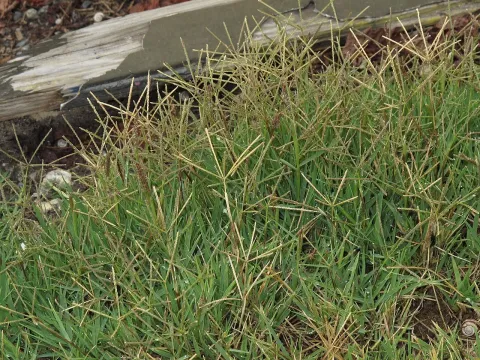
Bermuda grass
Cynodon
Bermuda grass, scientifically known as Cynodon dactylon, is a highly resilient perennial grass belonging to the Poaceae family. It is widely recognized for its aggressive growth habit and ability to spread through both rhizomes and stolons.
What the section contains
 Bermuda grass
Cynodon dactylon (L.) Pers.
Bermuda grass
Cynodon dactylon (L.) Pers. var. dactylon
Bermuda grass
Cynodon dactylon (L.) Pers.
Bermuda grass
Cynodon dactylon (L.) Pers. var. dactylon
 Bermuda grass
Cynodon dactylon ssp pulchellus
Bermuda grass
Cynodon dactylon ssp pulchellus
 Cynodon plectostachyus
 (K. Schum.) Pilg.
Cynodon plectostachyus
Cynodon plectostachyus (K. Schum.) Pilg.
 Magennis bermudagrass
Cynodon x magennisii Hurcombe
Magennis bermudagrass
Cynodon x magennisii Hurcombe
 Transvaal couch
Cynodon transvaalensis Burtt Davy
Transvaal couch
Cynodon transvaalensis Burtt Davy
Bermuda grass
Sowing typically occurs in late spring or early summer when soil temperatures reach at least 18 degrees Celsius. The seeds are extremely small, necessitating a shallow seeding depth of approximately 0.5 to 1 centimeter to ensure proper germination.
Because the seeds are tiny, ensuring good soil-to-seed contact is essential. Using a cultipacker after sowing helps firm the soil and maintains the moisture levels required for the seeds to establish successfully.
Vegetative propagation via sprigging or sodding is also a common practice. This method often results in a faster and more uniform turf or pasture cover compared to seeding, particularly in areas where weed competition is a concern.
During the establishment phase, consistent irrigation is critical. Once the root system is fully developed, the grass becomes exceptionally drought-tolerant and requires significantly less supplemental water.
Bermuda grass thrives in full sun and cannot tolerate shaded environments. It is best adapted to tropical, subtropical, and warm temperate climates where long, hot summers are the norm.
While it prefers fertile, well-draining soils, it is remarkably adaptable and can grow in various soil textures, ranging from sandy soils to heavy clay. It shows a high tolerance for soil salinity, which is a major advantage in certain regions.
The plant requires moderate levels of nitrogen fertilization to maintain its vigor and green color. Without adequate nitrogen, the grass may thin out, making it susceptible to encroachment by other plant species.
Soil pH should ideally be maintained between 6.0 and 7.5 for optimal nutrient availability. Although it tolerates a wide range of pH values, extreme acidity or alkalinity can inhibit growth.
The grass is known for its deep root system, which can reach depths of up to 1-2 meters in loose soil. This feature allows it to survive in arid conditions by accessing moisture from deep soil layers.
Bermuda grass is highly productive and serves as a premier forage crop for grazing livestock. Its ability to tolerate close grazing and frequent traffic makes it ideal for pasture management.
Under optimal management conditions with sufficient moisture and fertilizer, Bermuda grass can yield high quantities of biomass per hectare, making it a reliable source of hay during the growing season.
The nutritional value is highest during the rapid growth phase. Rotational grazing or timely harvesting ensures that the forage remains palatable and high in protein for cattle, sheep, and horses.
In addition to forage, it is widely used for erosion control. Its dense root and rhizome network binds the soil effectively, preventing loss due to wind and water runoff on slopes and disturbed areas.
Yields can vary significantly depending on the cultivar. Improved varieties have been developed to enhance biomass production, winter hardiness, and resistance to specific pests or environmental stresses.
Bermuda grass is generally robust, but it can be affected by diseases such as spring dead spot or dollar spot, particularly in managed turf or high-input pasture environments.
Insect pests like armyworms, cutworms, and mole crickets can cause damage by feeding on the leaves or tunneling through the soil and disturbing the rhizome network.
Weed management is most critical during the first few months of establishment. Once the sod is fully formed, it is generally dense enough to outcompete most common weed species.
Maintaining proper soil drainage is one of the most effective ways to prevent fungal pathogens. Waterlogged soils significantly weaken the plant's natural defenses.
Integrated pest management strategies, including monitoring and biological controls, are recommended to minimize chemical use and preserve the long-term health of the pasture ecosystem.
Forage harvesting is most effective when the grass reaches a height of 20-40 cm. Frequent cutting encourages new growth and maintains the quality of the harvested biomass.
When producing hay, the grass should be cut, dried quickly, and baled to ensure high nutrient retention. Bermuda grass hay is highly valued for its quality and palatability for livestock.
Seed production requires specialized management. Harvesting must be timed precisely to capture seeds before they shatter and fall to the ground, which is a common challenge with this species.
Modern equipment, such as rotary mowers and balers, significantly improves the efficiency of hay production, allowing farmers to capitalize on multiple harvests in a single season.
Proper storage is essential to prevent moisture accumulation and spoilage. Keeping bales in a covered, well-ventilated area ensures that the hay maintains its quality until it is ready for winter feeding.