
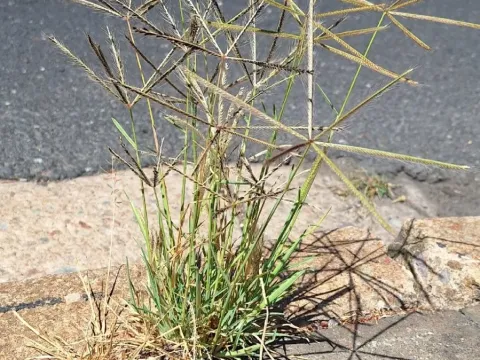
Windmill grass
Chloris truncata
Windmill grass (Chloris truncata) is a perennial grass species belonging to the Poaceae family, widely recognized for its characteristic windmill-shaped seed heads.
What the section contains
Windmill grass
The establishment of this grass typically occurs during the warm season when soil temperatures are high enough to support rapid germination and initial seedling growth.
Effective propagation relies on the plant's ability to produce large quantities of seeds that are easily dispersed by wind, allowing it to colonize disturbed areas efficiently.
In cultivated settings, seeds should be sown in prepared, well-aerated soil to ensure optimal contact for germination during the onset of summer rainfall.
Management of the seeding rate is crucial to avoid over-density, which can lead to increased competition between individual plants during the early vegetative stage.
Chloris truncata is known for its remarkable drought tolerance, making it a highly resilient species capable of surviving in harsh, low-rainfall environments.
It prefers sunny, open environments where it can receive maximum solar exposure, as it does not tolerate competition from taller vegetation or dense shade.
While it thrives in a variety of soil types, including sandy and loamy soils, it exhibits a particular preference for well-drained conditions to prevent root issues.
The species is quite adaptable to various nutrient levels, often persisting in soils that are considered marginal for more intensive agricultural production.
Temperature management is key; the plant performs best in warm climates and may go into dormancy during periods of extreme frost or cold winter temperatures.
Although primary production is generally lower compared to high-intensity fodder grasses, windmill grass provides essential forage cover in arid grazing systems.
The biomass yield is highly dependent on seasonal rainfall patterns and the level of nitrogen availability in the soil during the peak growing phase.
In well-managed pastures, it contributes to overall ground cover and soil stabilization, providing a secondary feed source for livestock throughout the year.
Harvesting for hay is possible but requires careful timing to ensure that the foliage quality is maintained before the plant enters its reproductive stage.
Overall, the economic output of this species is linked to its reliability as a perennial ground cover rather than high-volume forage production.
The plant can be susceptible to various fungal pathogens, especially rusts that affect the foliage and reduce the nutritional value of the plant.
Insect pests, including aphids and leafhoppers, may occasionally infest dense stands, potentially impacting plant vigor and spreading viral diseases.
Improper grazing management can lead to the overgrazing of sensitive areas, which may degrade the stand and expose the soil to erosion.
Chemical control for weed management requires precision, as the species can develop resistance to certain common herbicides if used repeatedly without rotation.
Monitoring for signs of root rot is advisable in regions with high humidity, as these conditions significantly increase the risk of fungal infections in the root zone.