
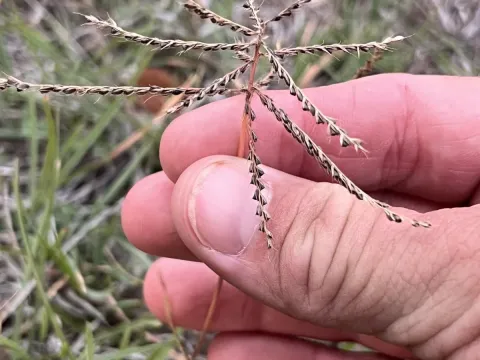
Windmill grass
Chloris verticillata
Windmill grass (Chloris verticillata) is a member of the Poaceae family, widely recognized for its adaptation to arid and semi-arid environments. It is a perennial grass native to North America, typically found in dry prairies, fields, and disturbed sandy soils.
What the section contains
Windmill grass
The plant possesses a robust root system capable of accessing water deep within the soil profile. This physiological trait allows it to thrive in regions where annual rainfall is sporadic and evaporation rates are high.
Botanically, the species is distinguished by its unique inflorescence, which consists of several spreading spikes arranged in a windmill-like pattern. These spikes detach easily when mature, allowing the plant to spread its seeds across vast areas via wind dispersal.
In terms of soil requirements, windmill grass is highly adaptable and can grow in poor, low-nutrient soils, including sands and clay-loams. It requires full sunlight to maintain vigor and density, making it unsuitable for shaded areas or dense canopy environments.
The primary agricultural use of Chloris verticillata is as a pasture grass in regions where high-input crops cannot survive. It serves as a vital tool for soil stabilization and erosion control on vulnerable or degraded rangelands.
Common fungal diseases, such as leaf rust and powdery mildew, represent the primary biological threat to windmill grass. These pathogens typically emerge during humid seasons, reducing the plant's photosynthetic capacity and overall forage quality.
Insect pests, particularly grasshoppers, pose a significant threat to the foliage. Heavy infestations can lead to substantial biomass reduction, which impacts the carrying capacity of pastures where the grass is established.
Overgrazing remains the most critical management threat. While the plant can tolerate moderate disturbance, sustained pressure from livestock destroys the crown and weakens the root structure, leading to long-term population decline.
Invasive weed species that compete for nitrogen and water pose a secondary threat. In highly disturbed areas, competition from aggressive non-native grasses can cause Chloris verticillata to lose its place in the local ecosystem.
Waterlogging and poor drainage are detrimental to the plant. Because it is evolutionarily adapted to well-drained soils, the lack of soil aeration leads to root rot and eventual plant mortality in damp or compacted sites.